


Understanding AI in Journalism

Artificial Intelligence (AI) refers to the use of complex algorithms and software to perform tasks typically requiring human intelligence. In recent times, the impact of AI on journalism has started influencing various industries. AI tools are revolutionising the news reporting process by automating routine tasks and assisting journalists with research and fact-checking. While artificial intelligence in journalism cannot replace human reporters, it is augmenting journalism by streamlining workflows and freeing up time for journalists to focus on deeper analytical stories.
The Future Landscape of AI in Journalism
Emerging Trends
Some key trends emerging in the field of AI and journalism include
- Automated Content Generation: AI is being used to write articles from financial statements, sports data or transcripts of events. This allows non-time-sensitive news to be produced faster. However, humans are still needed to write complex reports requiring analysis and interpretation.
- Social Media Monitoring: Tools like Twitris and Crimson Hexagon use AI to track, analyse and summarise large volumes of social media posts. This helps journalists identify breaking news and trending topics.
- Evidence-Based Journalism: Fact-checking websites like PolitiFact and Factmata use AI to verify the truthfulness of claims, statements or news reports. Automated algorithms check facts against comprehensive databases.
- Personalized News Delivery: AI plays a crucial role in analysing user interests and behaviours to provide a tailored news experience. Platforms like Apple News offer topic-based notification and a personalised news feed.
The Future Landscape of AI in Journalism
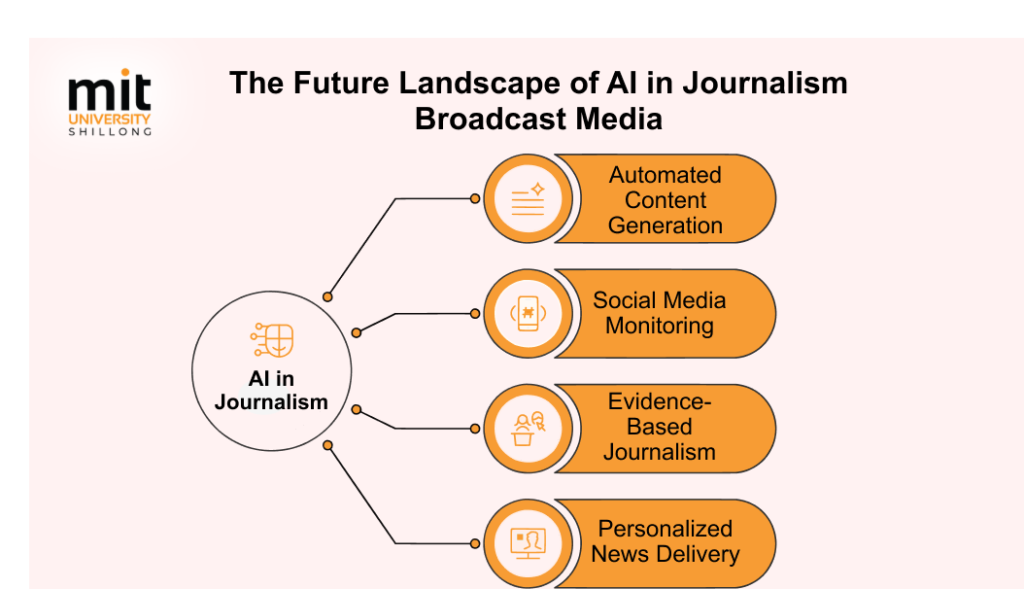
Some key trends emerging in the field of AI and journalism include:
Automated Content Generation: AI is being used to write articles from financial statements, sports data or transcripts of events. This allows non-time-sensitive news to be produced faster. However, humans are still needed to write complex reports requiring analysis and interpretation.
Social Media Monitoring: Tools like Twitris and Crimson Hexagon use AI to track, analyse and summarise large volumes of social media posts. This helps journalists identify breaking news and trending topics.
Evidence-Based Journalism: Fact-checking websites like PolitiFact and Factmata use AI to verify the truthfulness of claims, statements or news reports. Automated algorithms check facts against comprehensive databases.
Personalized News Delivery: AI plays a crucial role in analysing user interests and behaviours to provide a tailored news experience. Platforms like Apple News offer topic-based notification and a personalised news feed.
Key Statistics on AI in Journalism:
- AI produces routine articles 12 times faster than human writers
- Automated journalism accounts for 15-20% of major news content
- AI systems process over 100,000 social media posts per second
- Fact-checking speed improved by 70% with AI tools
- AI fact-checking maintains 85-90% accuracy rates
Government Support for AI in Journalism:
- Ministry of Electronics and Information Technology (MeitY) – Promotes AI innovation through Digital India initiatives
- Press Information Bureau (PIB) – Employs AI for fact-checking and official communications
- NITI Aayog’s National AI Strategy – Provides frameworks for responsible AI implementation in media
Integration with Human Journalism
While the impact of AI on journalism brings significant benefits, journalism will continue requiring human skills of analysis, empathy and ethics-based decision making. Here are some innovative ways AI and human journalists are collaborating:
- AI performs routine tasks like formatting, transcription, data processing to free up time for human reporters.
- Chatbots and virtual assistants answer basic user queries to reduce pressure on press offices and helpdesks.
- AI tools make sense of huge datasets and point out patterns/stories for journalists to explore further through primary research.
- Shared decision making where AI provides multiple options or scenarios to humans for selection and validation.
Innovative Use Cases
Let’s look at some real-world examples of AI putting news reporting on the fast track:
- The Washington Post’s robot reporter generates basic stories like earnings reports by extracting data from databases.
- NPR uses Anthropic’s tool to generate radio scripts from scheduled events with location and timings automatically inserted.
- Forbes hired automation tool Anthropic to write hundreds of articles on company earnings and U.S. elections results.
- BBC used AI to produce text, videos and social posts about the 2016 Rio Olympics and 2018 FIFA World Cup seamlessly.
Evolving Professional Roles
The integration of AI in journalism is reshaping traditional job roles and creating new career pathways. While automation handles routine reporting tasks, journalists are evolving into data analysts, AI trainers, and algorithm editors.
Emerging Roles in AI-Driven Newsrooms:
- Data Journalists – Specialists who analyze complex datasets to uncover stories and trends
- AI Content Editors – Professionals who review, refine, and fact-check AI-generated articles
- Automation Strategists – Experts who identify which stories can be automated and optimize AI workflows
- Multimedia Producers – Creators who combine AI-generated content with video, audio, and interactive elements
- Audience Engagement Analysts – Specialists using AI insights to understand reader preferences and behavior
Opportunities by AI in Journalism
AI promises significant opportunities for the journalism industry such as:
- 24/7 news coverage without limitations of location or time through robot journalism.
- Data-driven insights help focus reporting on topical issues affecting people’s lives.
- Fact-checking capabilities enhance accuracy and trust in news sources especially on social media.
- Personalised news caters to evolving audience preferences to engage more users.
- Automation of routine tasks frees up journalists to devote time on investigative, analytical stories.
- AR/VR tools bring distant events closer to home through interactive experiences.
Challenges and Ethical Considerations
While AI provides many advantages, it also poses challenges around over-reliance on algorithms, job losses, data privacy, bias and responsibility:
- Lack of human qualities like empathy, ethics and common sense in AI output.
- Algorithmic and data biases introduce unintended consequences unless carefully monitored.
- Loss of source-reporter relationships in algorithmic reporting reduces transparency.
- Job disruption for low-skilled reporters, though new roles around coding, data analytics emerge.
- Accountability issues arise in cases of factually incorrect AI-generated stories.
Conclusion
To conclude, AI is undoubtedly transforming journalism by improving workflows and delivery of round-the-clock news.
If you’re eager to explore how AI and other emerging technologies are reshaping industries like journalism, consider advancing your knowledge with a program from MIT University. Additionally, if you’re searching for Shillong colleges for BA or exploring options in specialised fields like gaming and animation design colleges in Shillong, MIT University provides a diverse range of programs that cater to both traditional and emerging sectors.
FAQs
What new skills do journalists need in the AI era?
Journalists now need data literacy, basic AI understanding, statistical analysis skills, and the ability to work with automation tools alongside traditional journalism skills.
Can readers tell if an article is AI-written?
Many news organizations now label AI-generated or AI-assisted content. While some basic articles may look similar to human writing, ethical journalism requires transparency about AI use.
What’s the future of AI in journalism?
Experts predict 80-90% of major newsrooms will integrate AI into workflows by 2025-2027, though adoption varies by organization size and resources.

Author Bio: Nitish Chitkara
Digital Marketing Head, MIT Group of Institutions | EdTech Strategist
Nitish Chitkara is the Digital Marketing Head at MIT Group of Institutions with 9+ years of experience in Paid Media and SEO. He loves writing about education, creating impactful systems, and transforming student careers through innovative learning solutions that change lives.
LinkedIn:
https://www.linkedin.com/in/nitish-chitkara-9583a0155/