

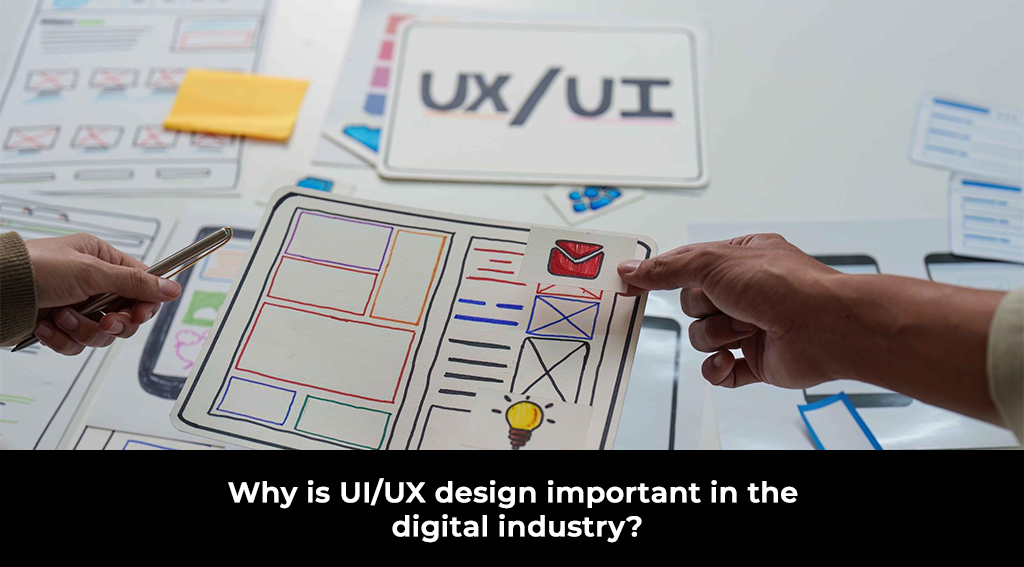
UI/UX design is considered important in the modern digital industry because it determines how efficiently, intuitively, and enjoyably people interact with software products. By aligning technical architecture with human behaviour, it directly reduces customer churn, lowers customer acquisition costs, and drives measurable commercial conversion.
Admissions for the 2027-28 academic batch are now officially open at MIT University India. Prospective designers who register their applications this week gain access to an exclusive design sprint workshop alongside tailored one-on-one portfolio evaluations from faculty mentors.
Why UI/UX Is Becoming a High-Value Digital Skill

Digital interactions have become the primary touchpoint through which modern businesses engage their consumers. Whether banking online, buying groceries, or running cloud-based enterprise systems, users expect interfaces to work seamlessly.
The discipline of UI UX design addresses this fundamental need by bridging complex code and human intention. While backend engineering builds operational mechanics, user experience design ensures those mechanics solve authentic user pain points with zero cognitive strain. Because seamless software interaction directly influences consumer loyalty, organisations prioritise hiring designers who can turn complex workflows into friction-free digital journeys.
Understanding the Growing Demand for UI/UX Designers

The massive acceleration of enterprise software and consumer apps has turned interface design into an urgent business priority. According to market data from the Grand View Research UI/UX Design Software Market Analysis, the global UI/UX software and tooling market is projected to reach USD 3.8 billion, expanding at an annual compound growth rate exceeding 18%.
Furthermore, Gartner’s Strategic Customer Experience Forecasts project that enterprises that prioritise dedicated digital product experience teams will outperform competitors by 25% in customer retention and brand advocacy. The World Economic Forum Future of Jobs Survey corroborates this trajectory, listing user experience professionals and product designers among the top growing digital specialist positions through 2026 and 2027.
Businesses recognise that functional code without clear visual usability leads to immediate product abandonment. Enrolling in an industry-aligned UI UX design course allows aspiring designers to secure practical capabilities within this rapidly growing economic sector.
What Does a UI/UX Designer Actually Do?
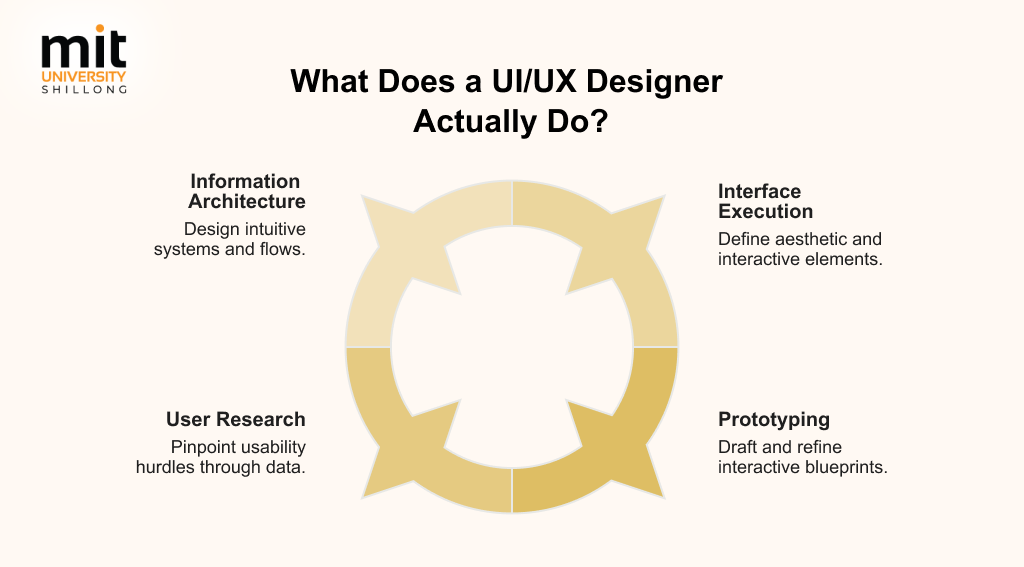
Many newcomers assume this field focuses solely on surface-level visual decoration. In professional production environments, the role requires analytical research, technical empathy, and systematic structural layout.
- Conducting Qualitative and Quantitative User Research: Designers run customer interviews, deploy surveys, and review user heatmaps to pinpoint usability hurdles.
- Architecting Information Systems: You design intuitive visual hierarchies, site maps, and navigation flows that let users achieve tasks with minimal clicks.
- Developing Wireframes and Prototypes: Specialists draft low-fidelity blueprints on paper or digital canvases, gradually refining them into interactive, clickable prototypes for testing.
- Executing Visual Interfaces: Through user interface design, practitioners define colour systems, micro-interactions, responsive grids, and typographic hierarchies that reinforce brand identities.
Practitioners continuously test their work with actual end-users, gathering feedback and refining screen layouts to ensure absolute usability.
Why Businesses Invest in UI/UX Design
Organisations invest heavily in product design because the commercial returns are immediate and quantifiable. The commercial advantages manifest across several measurable dimensions:
- Higher Conversion Rates: A Forrester study found that frictionless user interface design can boost conversion rates by up to 200%, while comprehensive usability workflows can lift conversions by up to 400%.
- Lower Development Costs: Fixing design flaws during early wireframing stages costs a fraction of the budget required to refactor code after launch.
- Reduced Customer Churn: Intuitive onboarding workflows help users realise value immediately, preventing them from migrating to competitors.
- Lower Support Overhead: Clear interactive interfaces eliminate user confusion, directly reducing incoming support tickets and call centre operational costs.
Skills You Need to Build a UI/UX Career
Succeeding in this competitive field requires balancing strategic analytical thinking with refined artistic execution. A premier curriculum develops practical capabilities across both spectrums.
- User Research and Usability Testing: You must master structured user interviews, usability metrics, A/B testing methodologies, and tree testing.
- Information Architecture and Journey Mapping: Designers construct comprehensive empathy maps, service blueprints, and user flows that document every customer touchpoint.
- Responsive Visual Design: You learn to adapt screen interfaces smoothly across mobile devices, tablets, desktop monitors, and wearable hardware.
- Interaction Design and Motion Mechanics: Applying micro-animations to buttons, page transitions, and status updates gives users clear feedback on their actions.
Mastering these core UI UX design skills ensures that your work delivers meaningful usability while maintaining structural elegance.
Tools Used by UI/UX Professionals
Modern digital product teams rely on specialised collaborative ecosystems to rapidly build, test, and document their design systems.
- Figma: The dominant industry standard for collaborative wireframing, visual interface composition, and shared design system maintenance.
- ProtoPie and Principle: Specialised high-fidelity prototyping tools that let designers engineer realistic sensor-driven mobile interactions.
- Miro and FigJam: Digital whiteboard platforms used for early-stage user empathy mapping, brainstorms, and information architecture mapping.
- Maze and Hotjar: Usability testing platforms that capture interaction heatmaps, recording drop-off rates and gathering direct qualitative feedback.
Learning these applications in integrated design studios ensures that you match the operational pace of real product teams from day one.
Comparing Digital Specialisations
Prospective students often compare user interface design with other related career options. The table below outlines how these functional roles contrast in actual project environments.
| Specialisation Dimension | User Experience (UX) Design | User Interface (UI) Design | Product Design |
| Primary Objective | Solving usability bottlenecks and streamlining the user journey. | Crafting visually appealing, accessible, and responsive screens. | Balancing user needs against commercial viability and development effort. |
| Key Deliverables | User personas, journey blueprints, and wireframe prototypes. | High-fidelity mockups, UI style kits, and component design systems. | End-to-end product strategy, feature roadmaps, and validated solutions. |
| Core Methodologies | Field interviews, contextual inquiry, and usability test metrics. | Typographic balance, colour theory, and kinetic micro-interactions. | Market competitor analysis, MVP definition, and agile cross-functional delivery. |
| Dominant Metrics | Task completion speed, error frequencies, and usability scores. | Aesthetic consistency, visual clarity, and brand recognition. | Monthly recurring revenue, user retention, and feature engagement. |
Selecting the right UI UX design college in India ensures you gain hands-on experience across each of these integrated disciplines. MIT University India structures its studio coursework so that students gain balanced exposure to research strategy, aesthetic craft, and commercial business execution.
UI/UX Career Paths You Can Explore
As the digital ecosystem expands, interface design continues to fracture into distinct specialist career tracks, allowing professionals to choose pathways that best match their talents.
- UX Researcher: Specialists who focus exclusively on behavioural observations, qualitative interviews, and generative data synthesis.
- Interaction Designer: Practitioners who specialise in screen choreography, micro-interactions, and kinetic responsiveness.
- Design System Engineer: Designers who build reusable UI component libraries that maintain visual consistency across complex enterprise product suites.
- Product Designer: Strategic leaders who oversee features from early problem discovery to final deployment, working directly alongside engineering teams.
How to Build a Strong UI/UX Portfolio
Your design portfolio remains the single most critical asset during your job search. Creative directors look past surface beauty and focus on how you navigate complex operational problems.
- Document Your Problem-Solving Logic: Structure every case study around the core user problem, your research findings, and your iterative design experiments.
- Show Failed Iterations: Detail the design variations that did not test well and explain how user feedback helped you pivot toward the final solution.
- Present Measurable Outcomes: Wherever possible, quantify your impact by citing improvements in conversion rates, task completion speeds, or usability scores.
At MIT University India, students receive personalised portfolio reviews from visiting industry leads, ensuring that their graduation portfolios present clear, commercial problem-solving case studies.
Final Thoughts
Digital products succeed or fail based on how effortlessly they serve human needs. Becoming a skilled UI/UX designer requires deep behavioral insight, systematic visual craft, and rigorous testing discipline.
Take charge of your creative trajectory by applying through the MIT University India design portal today! Admissions for the 2027-28 academic intake are open. Book your creative consultation and build products that make a genuine difference.
FAQs
Is UI/UX worth it in 2026?
Yes, UI/UX design remains exceptionally worthwhile. As digital software, wearable tech, and automated platforms expand across every industry, companies require qualified professionals who can turn intricate backend logic into human-friendly interactive interfaces.
Which is better, UI/UX design or digital marketing?
Neither discipline is universally superior because both serve complementary business objectives. Digital marketing attracts potential users to your product, whereas UI/UX design ensures they can navigate and use that product smoothly once they arrive.
Is AI replacing UI/UX designers?
AI accelerates routine operational tasks like basic wireframe generation and initial data analysis. However, it cannot replace authentic human empathy, qualitative user interviews, nuanced ethical considerations, or creative strategic collaboration.
Is UX design still in high demand?
Yes, high demand persists across enterprise software, healthcare, financial technology, and consumer applications. Companies consistently seek designers who can reduce operational software complexity and lower customer churn through thorough research.
Can good UI/UX design increase conversions?
Yes, substantially. As confirmed by findings from Forrester Research, implementing responsive user interface layouts can raise conversions by up to 200%, while structured user experience optimisation can generate conversion increases reaching 400%.
Leave a Reply