

If working with numbers excites you, or you love solving complex applied math problems, penetrating the banking and finance sector could be one of the wisest choices. And a B.Com in Financial Accounting can get you there. You’d develop accounting skills, taxation knowledge, and audit training.
Now, this blog is for students and parents exploring top colleges for B.Com. We give you a clear direction, starting from what financial accounting is, how you can apply for it, and what career opportunities you have.
What is a B.Com Financial Accounting Course?
A B.Com Financial Accounting course is a four-year undergraduate programme that trains you in financial reporting, taxation, auditing, and business law. It is also one of the most sought-after and career-focused accounting and finance courses, with roles available in the BFSI, MNC, and government sectors.
A financial accounting degree focuses on competencies such as:
- Organising financial data
- Creating financial statements
- Tax planning
- Calculating and filing taxes
- Overseeing audits
- Enabling businesses or organisations to work within the legal standards
- Contributing to the company’s financial strategies.
Why Choose B.Com Financial Accounting?

MIT University, Shillong, one of the top private colleges for B.Com, has been a long pioneer of providing quality collegiate education to the students of the Northeastern regions. But, over the years, it has also attracted youngsters from all over India for its robust campus and unparalleled curriculum structure.
Amongst its widely acclaimed courses, B.Com Financial Accounting stands out for the following reasons:
- Offers in-depth and practical knowledge of accounting and financial management.
- Lays a solid foundation to crack CA, CMA, CFA, and CS certifications.
- Takes on a problem-based learning approach.
- Updates the syllabus in accordance with the changes in GST, IFRS, and corporate governance.
- Has a strong alumni network that connects students with corporate firms, private accountants, and other financial services.
Eligibility Criteria
To apply for the accounting and finance course at MIT Shillong, candidates must meet the following eligibility criteria:
- Must have completed HSC/ (10+2) / 12 th from any stream or its equivalent examination with English as a mandatory subject.
- Should have secured 50% aggregate marks in the HSC examination.
- Must have studied Commerce, Mathematics, or Economics as a core subject.
Admission Process
The admission process at MIT Shillong is fairly simple and student-friendly:
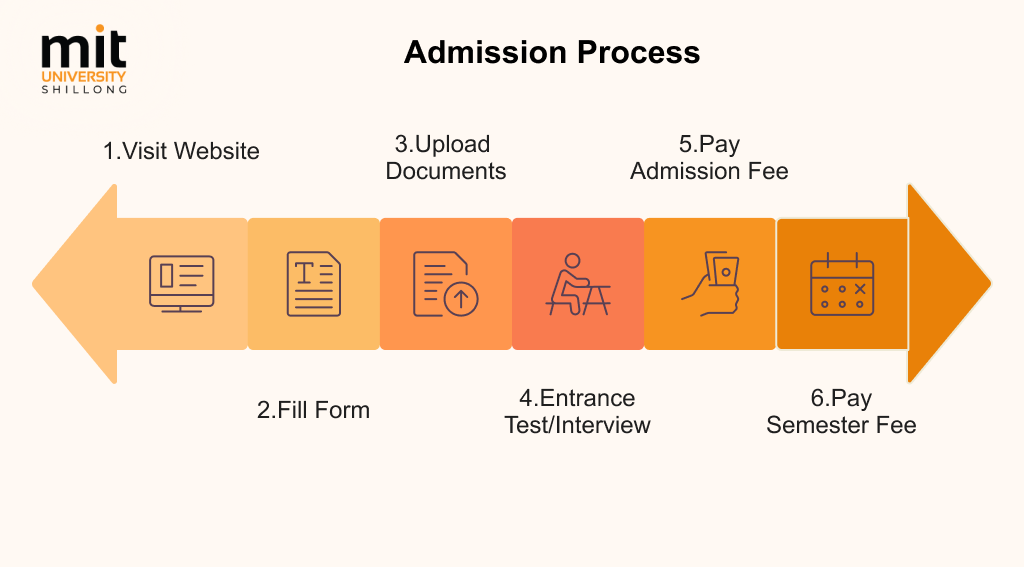
- Visit the official website:
- Fill the application form and pay the application fee.
- Upload and submit the required documents.
- Appear for an entrance test or interview.
- Pay the admission fee and confirm admission.
- Once you receive the admission letter, pay the semester fee and complete your course registration.
Course Duration and Structure
The duration of the financial accounting course is four years, with the option to pursue a honours degree as well.
| Year | Subjects Covered | Outcomes |
| Year 1 | Financial Accounting, Business Economics, Business Law | Read and analyse a basic set of accounts, understand commercial contracts, and apply economic principles in business decisions. |
| Year 2 | Corporate Accounting, Income Tax, Cost Accounting, Auditing and Assurance | Prepare financial statements, calculate tax liabilities, and understand the entire audit lifecycle from planning to reporting. |
| Years 3 & 4 | Management Accounting, Banking Theory and Practice, Financial Analysis, Business Mathematics and Statistics, Computer Applications in Accounting (Tally ERP, MS Excel) | Apply theory of finance to practical use, work with financial instruments and credit systems, complete a capstone project. |
Skills You Gain During the Course
This is where things get interesting because the skills you acquire during the course duration determine the rest of your career path.
| Skills | Description |
| Bookkeeping and Financial Reporting | Reconcile accounts, maintain general ledgers, and prepare Balance Sheets, P&L statements, and Cash Flow statements |
| Software Tools | Tally Prime, QuickBooks, and SAP |
| Advanced MS-Excel | Use complex functions, pivot tables, and financial modelling to automate data analysis |
| Taxation and Regulatory Compliance | Calculate and file corporate and personal taxes including GST, TDS, and Income Tax returns |
| Cost and Accounting Management | Perform break-even analysis, variance analysis, and budget preparation |
| Auditing | Review financial records for compliance with GAAP and International Financial Reporting Standards (IFRS) |
Career Opportunities After B.Com Financial Accounting
Once you graduate with a financial accounting degree, it opens doors to numerous opportunities. You can become a:
- Financial Analyst
- Financial Accountant
- Credit Analyst
- Tax Consultant
- Auditor
- Chartered Accountant
- Investment Banker
- Compliance Officer
- Chief Financial Officer
- Business Analyst
Industries Hiring Financial Accounting Graduates
| Industry | Who Hires You | Job Roles |
| Professional Services and Consulting | Accounting firms such as EY and Forvis Mazars | Auditing, taxation, risk management, client advisory |
| Banking and Financial Services | Public and private banks, insurance companies, microfinance companies | Hedge fund accounting, investment accounting, fund reconciliation |
| IT and Technology | SaaS companies, IT services, and product-based companies | Financial planning, revenue streamlining, SOX internal controls |
| Manufacturing and Automotive | Heavy automotive manufacturers, OEMs, suppliers, dealers, and research centres | Accounts payable, supply chain billing, inventory valuation |
| Healthcare and Pharmaceuticals | Biotech companies, pharmaceutical companies, hospitals, medical equipment manufacturers and suppliers | Statutory compliance, R&D compliance, payroll management |
FAQs
1. What is a B.Com in Accounting and Finance?
A B.Com Financial Accounting course is a four-year undergraduate course that trains you in financial reporting, taxation, auditing, and business law.
2. Can I pursue further studies after completing a B.Com in Accounting and Finance?
Yes. You can pursue M.Com in Financial Accounting, MBA in Finance, CA, CFA, CMA, or CS.
3. What skills will I develop during a B.Com Finance program?
Bookkeeping and financial reporting, auditing, ERP tools, taxation, analytical thinking, business communication, financial analysis, and strategic decision-making.
4. Can students from non-commerce backgrounds apply for this course?
Yes, Students from a Science and Arts background can also apply if they studied mathematics or economics as a mandatory subject.
5. Can I become a CA with a B.Com in accounting?
Yes. After a B.Com in Accounting, you can pursue professional certification courses like CA, predominantly because the ICAI CA syllabus and the B.Com Financial Accounting syllabus are nearly the same.
6. Is B.Com Financial Accounting a career-focused course?
Yes. You can become a financial analyst, a risk analyst, credit manager, and more.