

Introduction
Building a career in the creative field is a journey that begins long before you finish college. For students who are attending design colleges in Meghalaya, the most important asset you will ever own is not your degree certificate, but your portfolio. It is your visual voice, telling the story of who you are as a creator and how you solve problems. In the environment of Shillong, you have a unique opportunity to blend local inspiration with modern techniques to create something truly special.
Moreover, in 2026, the design industry looks for more than just a person who knows how to use software. Employers are also searching for complete designers. This is where soft skills education becomes your secret weapon. When you present your portfolio, you aren’t just showing pictures; you are communicating your thought process and your passion for learning. Integrating soft skills training into your portfolio development helps you explain the reason behind your designs, which is often more important to a client than the how. By focusing on soft skills for students, you prepare yourself to not just create art, but to lead projects and work effectively in teams.
What Is Graphic Design?
Graphic design is the art of solving problems through visual communication. It is much more than making things look pretty; it is about organizing information so that it is easy to understand and pleasant to look at. Whether it is a logo for a new cafe or an app interface for a local startup, graphic design helps bridge the gap between an idea and an audience. So, when you study at graphic design colleges in Shillong, you learn how to use colors, shapes, and fonts to evoke emotions and drive action. It is a mix of art and logic that makes our digital and physical world easier to find.
What Does a Graphic Designer Do?
A graphic designer is essentially a visual storyteller and a professional problem-solver. Your day-to-day work involves taking a brief set of instructions from a client and turning it into a visual reality. This requires a heavy dose of soft skills training, as you must listen carefully to what the client wants, ask the right questions, and explain your ideas clearly. Moreover, in the modern world, designers also spend a lot of time researching trends, testing how users interact with their designs, and collaborating with other professionals like writers and developers. You are the bridge that connects a business to its customers.
Why Do Graphic Designers Need a Portfolio?
In the design field, a portfolio is your real-world resume. It is the only way to prove that you actually have the skills you claim to have. For students in design colleges in Meghalaya, a portfolio serves as a bridge between their classroom assignments and a professional job. Moreover, it allows a potential employer to see your technical ability and your creative thinking in one place. Without a portfolio, it is nearly impossible to show that you have the soft skills for students, such as attention to detail and a commitment to quality. It is your proof of talent and your ticket to an interview.
Types of Graphic Design Portfolios
Not all portfolios are the same, and choosing the right format depends on your career goals. Most students today need at least two versions. First is a Digital Portfolio or website (like Behance or a personal site), which is easy to share globally. Second is a PDF Portfolio, which is a curated, shorter version tailored specifically for a particular job application. However, some designers still keep a Physical Portfolio, a high-quality printed book, which can make a massive impression during in-person interviews at design colleges in Shillong. Having multiple formats shows you are organized and ready for any situation.
Start With a Clear Theme
Your portfolio shouldn’t feel like a random collection of homework. It needs a theme or a vibe that represents you. Think of your portfolio as a curated gallery show. If you love bold, bright colors and modern shapes, let that shine through in how you arrange your work. Having a clear theme shows that you have undergone soft skills education in self-awareness and branding. It tells the viewer that you are a designer with a specific point of view and the discipline to stick to a professional aesthetic. A clear theme makes your work more memorable and professional.
Show Your Process, Not Just Final Designs

One of the biggest mistakes students make is only showing the finished product. Employers nowadays want to see your work, which means the entire process. They want to see the messy sketches, the failed ideas, and everything that you are doing to get the final logo. Showing your process is a brilliant way to demonstrate soft skills for students, such as critical thinking and patience. It proves that you didn’t just get lucky with a good design, but that you have a logical, repeatable way of solving creative problems. It builds trust because people can see exactly how your mind works.
The Core Pieces of a Portfolio for Design Students
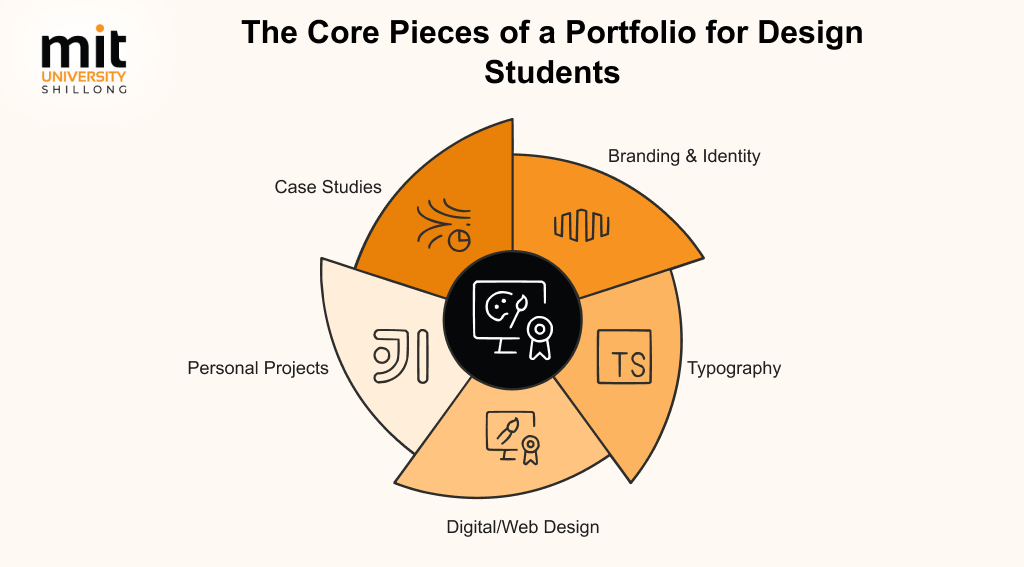
Your portfolio should be a balanced mix of different types of work to show your versatility. While studying at design colleges in Meghalaya, aim to include these core pieces:
- Branding & Identity- Logos and how they look on business cards or packaging.
- Typography- Projects where the focus is on creative and readable use of fonts.
- Digital/Web Design- Mockups of apps or websites that show you understand screens.
- Personal Projects- Work you did just for fun, which shows your true creative passion.
- Case Studies- At least two projects where you explain the problem and your solution in detail.
Steps to Build a Graphic Design Portfolio
Building a portfolio can feel overwhelming, but it is easier if you take it one step at a time. First, gather all your work from your years at the graphic design colleges in Shillong. Next, be your own harshest critic and pick only the top 5 to 8 projects that you are truly proud of. Then, write a short, engaging story for each project. Finally, choose a platform to host your work, like a personal website or a professional gallery site. This process is a great exercise in soft skills training, as it requires organization, time management, and the ability to look at your work from an outsider’s perspective.
Crafting Your Identity Through a Unique Portfolio
Your portfolio is the first client project, where the client is you. Use this opportunity to show your personality. If you are inspired by the natural beauty of Meghalaya, perhaps your portfolio uses organic shapes and earthy tones. Crafting a unique identity shows that you understand soft skills education regarding personal branding. It makes you stand out in a sea of other applicants and proves that you can create a cohesive “brand story” from scratch. Your personal identity is what makes a recruiter remember your name after they have closed their laptop.
Why Branding Matters in a Design Portfolio
Consistency is the mark of a professional. If your portfolio website uses one font, your resume uses another, and your business card uses a third, you look disorganized. Good branding in your portfolio involves using a consistent color palette, a signature font, and a professional tone of voice. This level of detail shows that you have mastered soft skills for students, such as consistency and professional presentation. It signals to employers that you are ready to handle their brand with the same level of care you give to your own.
Factors to Strategise Portfolio Content for Maximum Impact
To make the biggest impact, you need to think like the person who will be hiring you. If you are applying to a trendy ad agency, show your most creative, out-of-the-box work. If you are applying to a corporate tech company, show your clean and functional designs. This strategy requires soft skills training in empathy and research. By tailoring your content to your audience, you show that you aren’t just an artist but you are a professional who understands what a business needs to succeed.
Conclusion
Building a design portfolio while studying in design colleges in Meghalaya is an important and exciting process. Infact it is your chance to show the world what you are capable of and to prove that you have the right mix of technical skill and soft skills education. Institutions like MIT University Shillong emphasise this holistic approach, helping students develop the soft skills for students that turn a good portfolio into a job offer. Remember, your portfolio is a living document that keeps adding to it, keep refining it, and most importantly, let your unique Meghalayan perspective shine through. Good luck with your creative journey!
FAQs
1. How to make a graphic design portfolio better?
Focus on quality over quantity. Instead of 20 average projects, show 5 amazing ones with detailed case studies. Also, make sure your soft skills training shows through in how clearly you explain your work to others.
2. Can you get a design job without a portfolio?
In almost all cases, no. Even if you have the best degree from the best college in Meghalaya, employers need to see visual evidence of your work before they will consider hiring you.
3. Should my graphic design portfolio be a website?
Yes, in 2026, a website is the professional standard. It is easy to share and shows that you have basic digital literacy. You can use free platforms to get started and build your online presence.
4. How to create a good portfolio?
Start by picking your best work and organizing it in a way that makes sense for each project. Ensure the design of the portfolio itself is clean and doesn’t distract from the actual work.
5. What is a portfolio format?
The most common formats are a personal website or a high-quality PDF. Each has its own use depending on whether you are applying online or meeting someone in person.
6. What are the Graphic design portfolio examples?
Examples often include a mix of branding, digital design, and personal art. You can look at sites like Behance or Dribbble for inspiration to see how other students around the world lay out their work.