

Pursuing an MBA after a B.Tech is an incredibly smart career decision in 2026. Integrating a technical engineering foundation with advanced management skills directly addresses the global demand for techno-commercial leaders. This combination bridges the gap between complex engineering concepts and strategic business outcomes, preparing you for leadership roles, higher salary packages, and faster career progression compared to technical paths alone.
With the academic session for 2026 fast approaching, MIT University, Meghalaya, has opened its admissions. If you are looking to fast-track your leadership journey, you can benefit from our customised dual-specialisation pathways and early-enrolment scholarship schemes. Read below to learn more about how an MBA can be the best career decision after an engineering degree!
Why Engineers are Choosing an MBA in 2026
The professional landscape in 2026 is rapidly evolving. Emerging technologies like Artificial Intelligence, automation, and green energy require leaders who understand both the underlying technology and the business frameworks needed to scale them. For B.Tech graduates, relying solely on technical skills can sometimes lead to early career plateaus.
Key Statistics on Tech-Business Synergy –
- Salary Growth – Business school placement data reveal that B.Tech graduates who complete an MBA after engineering experience an average starting salary hike of 30% to 50% compared to those continuing in purely technical positions.
- Leadership Pipeline – Approximately 33% of CEOs in Fortune 500 tech companies hold an undergraduate degree in engineering, followed by a postgraduate degree in management.
To understand how this academic combination reshapes your professional trajectory, consider the comparison below –
| Feature | B.Tech Graduate (Technical Path) | B.Tech + MBA Graduate (Techno-Managerial Path) |
| Primary Job Focus | Core engineering, coding, system design, testing | Strategic planning, project management, and business scaling |
| Career Progression | Technical Lead, Principal Engineer, Architect | Product Manager, Consultant, Operations Director, CXO |
| Skill Set | Analytical thinking, coding, technical troubleshooting | Leadership, financial acumen, strategic marketing, negotiation |
| Average Salary Growth | Linear and steady | Exponential, with significant leadership bonuses |
| Global Mobility | Dependent on specific technical toolsets | Highly flexible across industries and geographies |
The Growing Demand for Tech-Savvy Managers
Modern corporations are no longer run in silos. Finance, human resources, and marketing departments rely heavily on data analytics, software tools, and digital pipelines. Because of this, companies are actively seeking leaders who do not require a technical translator.
An engineer with an MBA understands the development cycle of a product while also knowing how to budget, market, and sell it. This unique blend makes you an asset in high-growth fields like Product Management, Fintech, Supply Chain Management, and Management Consulting.
What is an MBA? Course Overview & Duration
A Master of Business Administration (MBA) is a globally recognised postgraduate degree designed to develop the skills required for careers in business and management.
- Duration – Typically a 2-year full-time programme divided into four semesters.
- Core Curriculum – Covers fundamental business areas including corporate finance, strategic management, organisational behaviour, operations, and marketing.
- Specialisations – In the second year, students can customise their learning by choosing specialised tracks such as Marketing, Human Resource Management, Finance, or Operations.
Best MBA Marketing Colleges for Career-Focused Management Education
Marketing in 2026 is no longer just about creative ad campaigns; it is heavily rooted in data analytics, consumer behaviour tracking, and digital ecosystems. B.Tech graduates are uniquely positioned to excel in this space because of their comfort with quantitative data.
When searching for the best MBA marketing colleges for career-focused management education, look for institutions that integrate marketing technology (MarTech) into their curriculum. A modern MBA course in Shillong or other educational hubs will focus on –
- Digital marketing analytics and predictive modelling.
- Product marketing strategy.
- Brand management in the digital age.
By choosing a university that aligns its curriculum with actual industry trends, engineers can transition seamlessly into high-paying Product Marketing Manager roles.
Benefits of Studying an MBA in Human Resource Management
Many B.Tech graduates overlook Human Resource Management (HRM), yet it remains one of the most critical functions in the technology sector. Technical companies face high turnover rates and unique workforce challenges.
Some key benefits of studying an MBA in Human Resource Management as an engineer include –
- Understanding Technical Teams – You understand the work habits, pressures, and aspirations of software engineers and developers, making you an exceptionally empathetic and effective HR leader.
- Data-Driven HR – Modern HR relies on people analytics and workforce planning software—skills that engineering minds master quickly.
- Strategic Organisation Design – You can play a pivotal role in restructuring tech organisations to foster innovation.
Career Opportunities After MBA for B.Tech Graduates
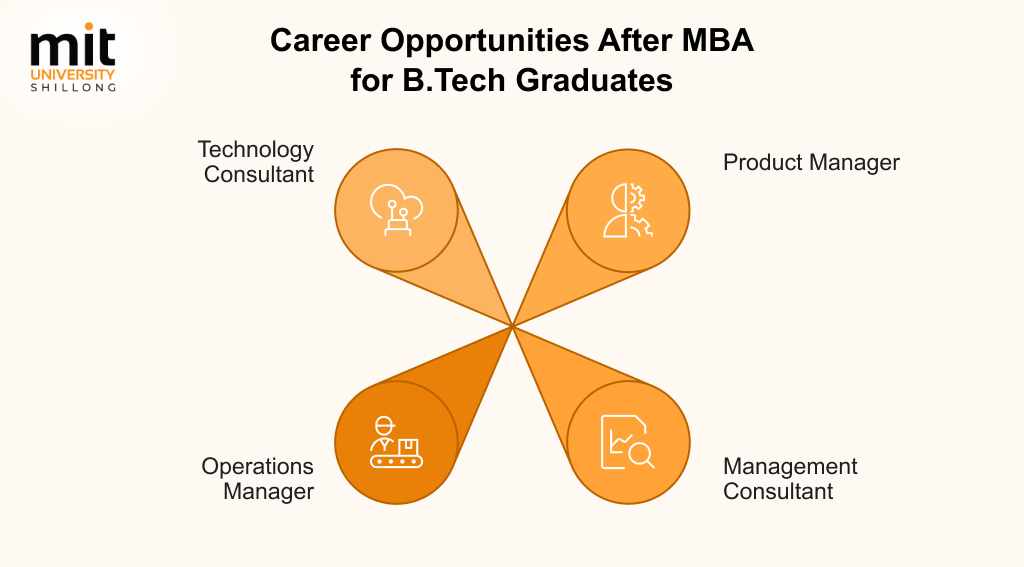
Completing an MBA after engineering opens up diverse, high-growth career avenues. Here are some of the most lucrative paths –
- Product Manager – Bridging the gap between software developers, designers, and business stakeholders to design and launch digital products.
- Management Consultant – Solving complex business problems for major corporations, often with a focus on digital transformation.
- Operations Manager – Optimising manufacturing processes, logistics, and supply chains using lean methodology and technical tools.
- Technology Consultant – Advising companies on how to integrate new software, cloud computing solutions, and AI tools into their business frameworks.
How to Apply for MBA Admission in Guwahati Universities and Shillong
If you are looking to study in the northeastern region of India, applying for management programmes is straightforward –
- Check Eligibility – You typically need a bachelor’s degree (like B.Tech) with a minimum of 50% aggregate marks.
- Entrance Exams – Most universities accept national-level entrance scores such as CAT, MAT, CMAT, or state-specific exams.
- Application Submission – Visit the official portal of your chosen university to submit your application form, academic transcripts, and entrance scores.
- Group Discussion & Personal Interview (GD/PI) – Shortlisted candidates are usually invited for an interactive round to assess communication skills and leadership potential.
For those looking at institutions in neighbouring regions, exploring options at top MBA colleges in Meghalaya offers a competitive edge due to their updated curricula and lower student-to-faculty ratios.
Why Choose an MBA College in Shillong for Management Studies
Shillong has rapidly transformed into a premier educational hub in Northeast India. Choosing to pursue an MBA in Shillong provides several distinct advantages –
- Optimal Learning Environment – The calm, pollution-free, and scenic environment of Meghalaya offers a focused atmosphere for rigorous academic study.
- Industry-Aligned Academics – The best MBA colleges in Shillong focus heavily on experiential learning, live industry projects, and regional economic case studies.
- Personalised Attention – Unlike overcrowded universities in metro cities, MBA colleges in Shillong, like MIT University, offer smaller batch sizes, allowing for personalised mentorship, tailored career counselling, and customisable project options.
Is MBA After B.Tech Worth It? Final Verdict
Pursuing an MBA after a B.Tech is a highly worthwhile investment in 2026. While an engineering degree teaches you how to build a product, an MBA teaches you how to sell, scale, and manage it. This combined skillset makes you highly resilient to market shifts and positions you at the forefront of business innovation.
FAQs
Which are the best MBA marketing colleges for career-focused management education?
The best colleges are those that blend traditional marketing principles with modern digital technology and data analytics. Look for institutions like MIT University, Meghalaya, that offer industry-relevant marketing modules, internships, and dual-specialisation options.
What are the benefits of studying MBA in Human Resource Management?
Studying HR management equips you to lead talent acquisition, design progressive organisational policies, and handle workforce planning. For engineers, it offers a pathway to manage highly technical teams and drive organisational productivity through data-driven HR practices.
How can students apply for MBA admission in Guwahati universities?
Students can apply by registering on the respective university portals, submitting their academic scores (such as B.Tech transcripts), and providing valid scores from management entrance tests like CAT, MAT, or CMAT, followed by a personal interview process.
Why should students choose an MBA college in Shillong for management studies?
An MBA course in Shillong offers a peaceful learning environment, highly personalised mentorship, lower student-to-faculty ratios, and access to developing economic sectors in the Northeast, making it an ideal destination for a focused management degree.