

Introduction
One of the first questions students ask before applying is: “What degree is required for an MBA?” This is natural because an MBA is not just another postgraduate program—it is one of the most sought-after qualifications for building careers in business, finance, consulting, and entrepreneurship. Every year, thousands of graduates from different academic backgrounds—engineering, commerce, arts, and even pure sciences—apply for MBA programs in India and abroad. But while the degree requirement is generally flexible, understanding the MBA admission requirements clearly can save you time and help you plan better. Whether you’re aiming for the best MBA colleges in Shillong or considering global B-schools, knowing the eligibility and degree pathways is the first step toward your MBA journey.
General Eligibility Criteria for MBA in India

India has the world’s second largest higher education system, with over 58,000 institutions and 43.3 million students enrolled, an 18 per cent increase over five years. In India, MBA eligibility is defined by guidelines set by the All India Council for Technical Education (AICTE) and followed by most universities:
- A Bachelor’s degree in any stream (Arts, Commerce, Science, or Engineering).
- A minimum of 50% aggregate marks (45% for reserved categories).
- Admission through entrance exams such as CAT, MAT, XAT, or CMAT.
This flexibility makes the MBA one of the most accessible postgraduate options, attracting students from diverse academic backgrounds.
What Degrees Commonly Lead to an MBA?
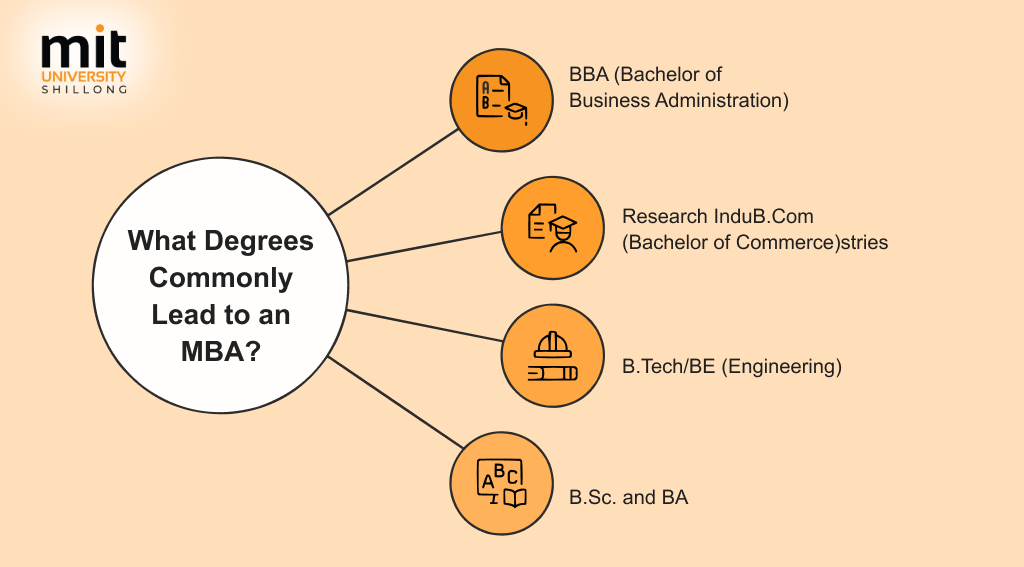
Although any recognized bachelor’s degree qualifies, certain degrees are more common stepping stones:
- BBA (Bachelor of Business Administration): Offers a strong management foundation.
- B.Com (Bachelor of Commerce): Preferred by students aiming for MBA Finance or HR.
- B.Tech/BE (Engineering): Popular for MBA in Operations, IT, or Analytics.
- B.Sc. and BA: Increasingly common for those shifting into management roles.
For students in the Northeast, there are reputed BBA colleges in Meghalaya and Assam that provide a solid base for pursuing an MBA later.
Degree Requirements for MBA Abroad
When applying abroad, the degree required for an MBA also remains a bachelor’s degree in any discipline. However, foreign universities often add:
- Standardized test scores, such as GMAT or GRE.
- Work experience (2–5 years for top schools).
- Strong letters of recommendation and a Statement of Purpose.
Top business schools in the US, UK, and Europe give significant weight to professional experience alongside academic background.
Can You Pursue an MBA Without a Bachelor’s Degree?
A common question is: “Can I do an MBA without a bachelor’s degree?” In India, the answer is no. A recognized undergraduate degree is mandatory for MBA admission requirements. However, some international universities and online platforms offer Executive MBAs to professionals with extensive work experience, even if they lack a traditional bachelor’s degree.
What Are the Benefits of Studying an MBA in Human Resource Management?
An MBA in Human Resource Management is one of the most versatile specialisations, preparing graduates to manage an organisation’s most valuable asset: its people. As companies compete harder for talent and invest in workplace culture, skilled HR professionals have moved from back-office administration to strategic, leadership-facing roles. Key benefits include:
- Strong career demand across sectors such as IT, BFSI, manufacturing, healthcare, e-commerce, and consulting
- Clear growth path from HR executive to HR manager, HR business partner, and eventually CHRO
- Competitive pay that rises sharply with specialisation, with senior roles reaching leadership-level packages
- Cross-industry mobility, since HR skills transfer easily between different types of organisations
- Exposure to high-value specialisations like HR analytics, talent acquisition, compensation and benefits, and learning and development
- Leadership and people-management skills that stay relevant even as AI automates routine HR tasks
- Suitability for freshers, offering one of the smoother entry points into corporate management for graduates from any stream
An MBA in HRM suits students who enjoy working with people, solving organisational problems, and shaping company culture, making it a stable and future-ready career choice.
Skills That Matter Beyond the Degree

While having the right degree ensures eligibility, successful MBA candidates also bring in essential skills:
- Analytical and problem-solving ability
- Communication and leadership skills
- Quantitative aptitude
- Teamwork and adaptability
According to the AISHE report, about 12.1 per cent of students are enrolled at the postgraduate level, and Management is among the top postgraduate streams, accounting for 14 per cent of master’s-level enrolment. Students preparing for MBA admission in Shillong or applying to the best MBA colleges in Shillong should focus equally on skill development and eligibility criteria.
Conclusion
So, what degree is required for an MBA? Any recognized bachelor’s degree is enough to qualify. Whether you come from B.Com, B.Sc, B.Tech, or BBA, what matters most is your dedication, entrance exam performance, and skill set. With India’s growing economy and global opportunities, pursuing an MBA from reputed institutes—be it the best MBA colleges in Shillong or international universities—can open doors to leadership roles and high-growth careers.
FAQs
Can I do an MBA after B.Com/B.Sc/B.Tech?
Yes. Students from all these degrees are eligible, provided they meet the minimum marks and entrance exam requirements.
What is the minimum percentage required for an MBA in India?
Generally, 50% marks (45% for reserved categories) are required in undergraduate programs.
Can I do an MBA without work experience?
Yes. Many colleges in India accept fresh graduates, though work experience is valued by top global programs.