


Engineering remains among the most sought-after fields in India. Still, the first big decision comes even before stepping into a classroom — choosing between a Bachelor of Engineering (B.E.) and a Bachelor of Technology (B.Tech).
The differences are not just in the name. From curriculum structure to industry exposure, the two paths are designed with distinct outcomes in mind. This B. Tech vs B.E. comparison will take you through the real contrasts, give you a clear picture of the opportunities ahead.
What Is B.E.?
A B.E. programme is often theory-focused. It aims to build a robust academic foundation in engineering principles, research, and conceptual understanding. This degree is suitable for students who are inclined towards research, advanced studies, or academic careers.

What Is B.Tech?
A B.Tech programme focuses on practical application. Students learn through industry projects, internships, and hands-on labs. The aim is to prepare graduates for the demands of the current job market.
What are the benefits of studying a B.Tech course?
A B.Tech course provides a robust foundation in engineering principles, advanced coding, and technical problem-solving to make you highly employable in the booming technology sector. The global software market is officially expected to create over 2 million new engineering jobs by the end of 2025. Students can choose specializations in artificial intelligence, cloud computing, or robotics. With spring tech conferences right around the corner, international companies are aggressively hiring young tech graduates to build innovative software tools.
- Unlocks highly paid roles in software development, cloud architecture, machine learning, and data engineering.
- Builds advanced analytical reasoning, quantitative logic, and complex system design skills.
- Provides fantastic global mobility because software engineering skills remain universally demanded across all continents.
- Encourages entrepreneurial thinking and provides the technical know-how required for launching successful tech startups

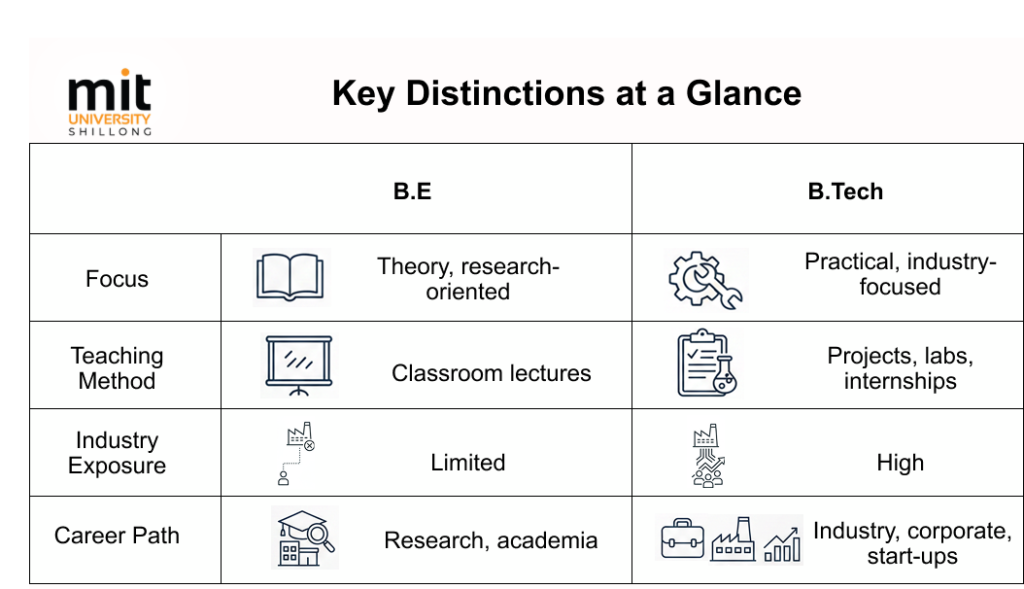
Key Distinctions at a Glance
| Aspect | B.E. | B.Tech |
| Focus | Theory, research-oriented | Practical, industry-focused |
| Teaching Method | Classroom lectures | Projects, labs, internships |
| Industry Exposure | Limited | High |
| Career Path | Research, academia | Industry, corporate, start-ups |
B.E. Typical Structure
B.E. programmes typically involve a deep study of engineering concepts, with less emphasis on real-world applications. Practical work is included, but the pace is slower compared to technology-focused programmes.
B.Tech Advantage at MIT University
One of the most significant advantages of a B.Tech degree over a B.E. degree is the exposure to real-world industry work early in the course. At MIT University, B.Tech students participate in live projects, internships, and skill development sessions that directly align with current market needs. This is an essential factor to consider when deciding why to choose B.Tech over B.E.
Specialisations That Propel You Forward
Why Specialise Early?
Specialising early helps you focus on a particular field, build targeted skills, and stand out in job applications. Many B.Tech specialisations in India are designed to meet the high demands of industries.
MIT University’s B.Tech Streams:
- Computer Science and Engineering
- Civil Engineering
- Electronics and Communication Engineering
- Mechanical Engineering
- Electrical Engineering
Alongside engineering, students can also explore creative fields through B. Des Design College in Shillong, or business education through Top MBA Colleges in Meghalaya.
Career Trajectories—Where Will You Land?
B.E. Career Map
B.E. graduates often enter research roles, academia, or industries where deep theoretical knowledge is valued. Some also pursue higher studies before joining the workforce.
B.Tech Career Map at MIT University
Graduates from MIT University B.Tech courses often secure roles in IT, manufacturing, construction, and electronics industries. Practical experience gained during the course makes the transition to work smoother.
Is B.Tech Right for You?
Self-Assessment Checklist
- Do you prefer hands-on learning?
- Are you looking for quicker entry into the job market?
- Do you want internships and real project exposure during your course?
Suppose you answered yes to most of these, why choose B. Tech becomes clear.
When to Pick B.E.
- If your goal is research or academia.
- If you enjoy deep theoretical work.
- If you plan to pursue a master’s or PhD right after graduation.
Why MIT’s B.Tech Wins
The mix of B.Tech specialisations in India offered at MIT, combined with strong placement support, industry partnerships, and modern labs, positions students for success from day one. Being located in Shillong also means access to a growing academic hub, which complements career opportunities in the North East and beyond.
Final Thoughts Before You Decide!
The choice between B.E. and B.Tech depends on your career plans and preferred learning style. This B. Tech vs B.E. comparison shows that both have value, but if practical skills, early industry exposure, and direct job readiness are your priorities, the B.Tech advantages over B.E. are significant.
With the range of MIT University B.Tech courses available, students can find a stream that aligns perfectly with their goals, while also exploring opportunities in related areas, such as B.Des Design College in Shillong and Top MBA Colleges in Meghalaya.