


Yes, a BBA is one of the smartest degrees you can pick after Class 12 if business, leadership, or entrepreneurship interests you at all. It gives you an early start in management and opens doors across almost every industry. Plus, it sets you up neatly for an MBA later.
Unlike theory-heavy degrees, a good BBA blends classroom learning with internships, live projects, and real skill-building. So you graduate ready to work and study further if you want.
This guide walks you through everything you need to decide, from what you learn to where it leads.
Why BBA Is Becoming a Popular Choice After 12th
BBA has quietly become one of the most chosen undergraduate routes, and the reasons are practical.
- Early management exposure: you learn leadership and business thinking at 18, not 22.
- Industry-ready design: internships and live projects are built into the course.
- Broad eligibility: students from commerce, science, and arts can all apply.
- A clear MBA pathway: it forms the ideal foundation for postgraduate management study.
Why Choose BBA After 12th?
BBA after 12th gives you an early start in corporate and management training, preparing you directly for the workforce or advanced degrees like an MBA. While others wait until postgraduate study to learn management, you build those skills three years sooner.
This means richer internships, sharper interview performance, and a real edge when you apply for entry-level roles. That early exposure compounds over time, so by the time your peers begin their management journey, you are already ahead.
There are several more reasons worth weighing carefully:
- Versatility
The degree fits finance, marketing, HR, operations, and more. You are never boxed into one path, so you can explore different fields before committing to a specialisation that genuinely suits you.
- Practical learning
Case studies, live projects, and internships teach you how businesses actually run. Instead of memorising theory, you apply it to real situations, which is exactly what recruiters look for in fresh graduates.
- Entrepreneurial grounding
It gives aspiring founders the basics of running a venture. You learn finance, marketing, and operations together, so a business idea becomes far easier to plan, launch, and manage.
- Confidence and communication
Presentations, group work, and teamwork build the soft skills every employer wants. These abilities often decide who gets promoted, not just who gets hired.
- Affordable entry point
Compared with many professional degrees, a BBA is relatively accessible. It offers strong career value without the high cost or long duration of some alternatives.
So if you want direction and employability early, choosing a BBA after 12th is a decision that pays off well beyond graduation.
What Do You Learn in a BBA Program?

A BBA is a three-year degree, usually across six semesters, that covers the full spread of business. You start with the fundamentals and grow into specialised, applied knowledge by the final year.
The core areas typically include:
- Management principles: how organisations are structured and led.
- Marketing: understanding customers, branding, and campaigns.
- Finance and accounting: reading numbers and managing money.
- Human resources: hiring, training, and managing people.
- Operations: running processes efficiently and at scale.
- Business analytics: using data to make smarter decisions.
Modern programmes increasingly add trending subjects too, such as digital marketing and AI tools. So the BBA course details you should look for go well beyond dusty textbook theory.
Popular BBA Specialisations
Choosing a specialisation lets you focus your degree on where you want to work. In 2026, specialised graduates are favoured over generalists, especially in tech-driven industries.
| Specialisation | Best suited for | Why it stands out |
| Finance | Numbers-focused students | High demand in banking and fintech |
| Marketing | Creative, people-oriented students | Fuels branding and digital campaigns |
| Business Analytics | Logical, data-loving students | Fastest-growing, highly employable |
| Human Resources | Communicators and organisers | Every company needs strong HR |
| International Business | Globally minded students | Opens doors to MNCs and trade |
Business Analytics, Finance, and International Business currently offer some of the highest salary potential. So pick a specialisation that matches both your strengths and where demand is climbing.
Career Opportunities After BBA

Fresh graduates typically start in trainee or executive roles, then climb quickly into management. It is one reason the Best BBA Marketing colleges in Assam place such heavy emphasis on real industry exposure from the first year.
Common BBA career opportunities include:
- Business Development Executive: driving sales and new client growth.
- Marketing Executive: running campaigns and building brand presence.
- HR Executive: managing recruitment and employee relations.
- Financial Analyst: studying data to guide money decisions.
- Operations Executive: keeping business processes running smoothly.
- Management Trainee: a fast track into leadership roles.
Beyond these, many graduates launch their own ventures, supported by the grounding a BBA provides. Hence, the range of BBA career options stretches from corporate ladders to entrepreneurship, depending on your ambition.
Industries Where BBA Graduates Can Work
One big advantage of a BBA is that it does not lock you into a single field. The broad foundation fits almost any sector, which keeps your options genuinely open.
Graduates find roles across:
- Banking and financial services, where analytical skills are prized.
- Consulting, which values sharp problem-solvers.
- FMCG and retail, driven by marketing and sales talent.
- E-commerce and IT services, both expanding fast in India.
- Startups, where versatile all-rounders thrive.
This flexibility explains why demand for BBA in India stays consistently strong. So whatever industry excites you, the degree likely has a place in it.
Skills You Can Develop Through BBA
A BBA shapes how you think and work, not just what you know. These skills stay with you across every job and industry you ever enter.
- Leadership: guiding teams and taking responsibility early.
- Communication: presenting ideas clearly and persuasively.
- Analytical thinking: breaking down problems & finding solutions.
- Time management: juggling deadlines, projects, and priorities.
- Teamwork: collaborating with different people towards one goal.
Top programmes now sharpen both soft skills and hard skills like data visualisation and CRM tools. So the growth you gain reaches far beyond your marksheet.
Higher Studies After BBA
Sometimes a job comes first, though many graduates choose to study further and specialise. A BBA sets you up perfectly for several advanced routes.
Your main options include:
- MBA: the most popular next step, often lifting salary packages significantly.
- Master’s in specialised fields: finance, marketing, or analytics, for deeper expertise.
- Professional certifications: in digital marketing, data analytics, or project management.
An MBA, in particular, can transform your career trajectory and earning potential. So think of your BBA as a strong launchpad, whether you work first or study on.
How to Choose the Right BBA College
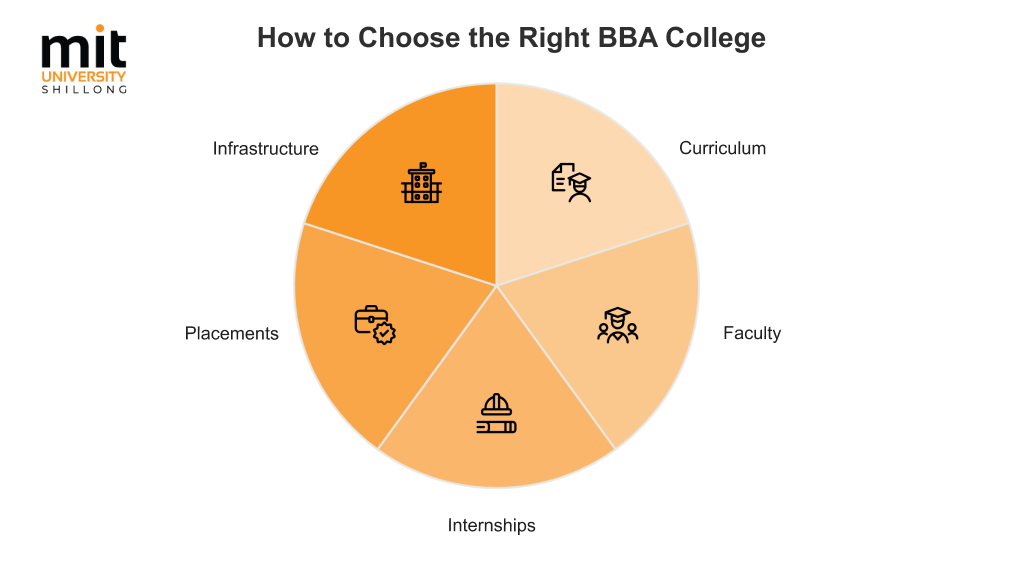
Your BBA college shapes how much value you actually get from the degree, so choose carefully. The best institutions treat business education as a practical discipline, not a purely classroom one.
Weigh these factors before you decide:
- Curriculum: is it current, applied, and industry-aligned?
- Faculty: do teachers bring real corporate experience?
- Internships: does the college guarantee genuine industry exposure?
- Placements: what is the recruiter network and placement record?
- Infrastructure: are there active clubs, competitions, and modern facilities?
Students exploring BBA colleges should visit campuses and speak to current students where possible. Strong BBA colleges in Guwahati tend to stand out through their internship and placement links, since hands-on exposure matters far more than glossy brochures. So judge each option on real outcomes, not reputation alone.
Take the First Step Towards Your Business Career
A BBA rewards students who treat it as a launchpad rather than just a certificate, so approach it with intent. Choose a specialisation that fits your strengths, take your internships seriously, and build practical skills alongside your grades.
If you are ready to step into the business world, a career-focused BBA programme at MIT University Shillong offers industry exposure, mentorship, and placement support to help you thrive. Explore the specialisations, connect with the faculty, and take your first real step towards a management career this admission season.
What is BBA and why should I choose it after 12th?
It is a 3-year undergraduate degree in business administration and management. You can choose it after 12th to build early management skills, explore broad career options, and follow a clear path to an MBA.
Is BBA a good course to pursue after 12th?
Yes, especially if you are drawn to business, leadership, or entrepreneurship. With management hiring growing 12 to 15% a year, demand for graduates stays strong.
What are the best BBA specialisations?
Business Analytics, Finance, and International Business offer some of the highest salary potential in 2026. Marketing and HR remain strong, people-focused choices too.
Can I get a job immediately after completing BBA?
Yes. Many graduates start in trainee or executive roles across banking, marketing, HR, and operations. Strong internships and skills make immediate placement far more likely.
Leave a Reply