

Making the decision to be a professional in healthcare means stepping into a role where every single step you take makes a tangible difference in someone’s life. Choosing a career in healthcare is a major commitment for students and their families, as it shapes a lifetime of stability and purpose. When a young person feels drawn toward patient care, finding a trusted educational path becomes the top priority. Established institutions like MIT Shillong offer structured learning environments for aspiring practitioners, and provide them with the right training ground for their professional development. Let us break down what it takes to build a successful career through a GNM nursing course.
What is a GNM Nursing Course?
A General Nursing and Midwifery programme is a three and a half year diploma course designed to prepare students for clinical practice, community health work, and patient management. Recent healthcare statistics indicate that the demand for qualified clinical staff across India continues to rise sharply, with the nation requiring millions of additional medical professionals to meet standard patient-to-nurse ratios. This academic path combines theoretical medical knowledge with extensive hospital rotations, ensuring you understand the practical realities of ward management, emergency response, and bedside care from day one.
When you study at institutions recognised among the best nursing colleges in India, you gain exposure to modern medical equipment and diverse patient demographics. The curriculum emphasises holistic care, teaching you how to treat not just the physical symptoms of an illness, but also the emotional and psychological needs of patients and their families.
This comprehensive approach ensures that upon graduation, you are fully equipped to handle the high-pressure environment of modern emergency rooms, intensive care units, and community health camps without feeling overwhelmed by daily clinical challenges.
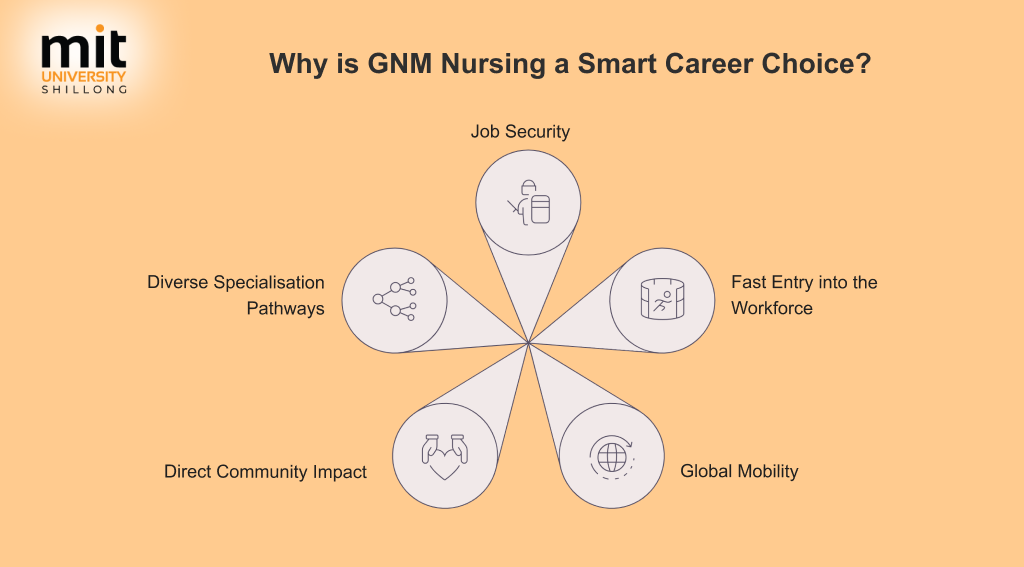
Why is GNM Nursing a Smart Career Choice?
Entering the medical sector through a recognised diploma opens doors to immediate employment without requiring a four year degree upfront.
- Job Security – Healthcare providers always need trained clinical personnel, making this field largely recession-proof and immune to shifting economic downturns.
- Fast Entry into the Workforce – You start earning and gaining hands-on hospital experience much sooner than many other university graduates.
- Global Mobility – Qualified clinical professionals find numerous job opportunities abroad, particularly in regions facing severe staff shortages in public and private hospitals.
- Direct Community Impact – Your daily work directly improves patient recovery rates and public health outcomes within local communities.
- Diverse Specialisation Pathways – The diploma acts as a stepping stone to various advanced medical fields through continuous learning and targeted certifications.
What Will You Learn During a GNM Nursing Course?
The curriculum is structured to build your medical knowledge progressively.
- During the initial months, you study foundational sciences like anatomy, physiology, microbiology, and fundamental nursing procedures.
- As you advance, the syllabus covers medical-surgical nursing, mental health nursing, child health care, and midwifery.
- Practical hospital postings run concurrently with classroom lectures, allowing you to apply classroom theories directly to patient care under the watchful eyes of experienced clinical instructors.
- Furthermore, students learn about pharmacology, medical ethics, nutritional science, and first aid management. Understanding how different medications interact within the human body is crucial for preventing clinical errors during treatment administration.
- Ward management modules also teach you how to maintain medical records, manage hospital inventories, and coordinate effectively with attending physicians, surgeons, and laboratory technicians during critical patient interventions.
Skills You Gain During a GNM Nursing Course
Technical medical knowledge must be paired with sharp observational skills to handle emergency situations effectively. Throughout your studies at one of the top GNM nursing colleges, you will develop strong competencies in
- Administering medications accurately according to strict clinical dosages and physician prescriptions.
- Monitoring vital signs and identifying sudden changes in patient stability or cardiac rhythm.
- Wound care, dressing changes, and maintaining strict aseptic infection control standards across hospital wards.
- Operating advanced hospital monitoring equipment, oxygen delivery systems, and emergency resuscitation tools.
- Compassionate patient communication, active listening, and psychological support for distressed families.
- Triage assessment in busy emergency departments to prioritise patients based on medical urgency.
Career Opportunities After Completing GNM
Graduating with a diploma in general nursing and midwifery opens up diverse employment settings across the public and private medical sectors. You can work as a Staff Nurse, Community Health Worker, Home Care Nurse, Industrial Nurse, or Military Nursing Assistant. Major multispecialty hospitals, government health clinics, old age homes, and rehabilitation centres constantly recruit qualified diploma holders to manage daily ward operations and patient monitoring schedules.
Beyond traditional hospital wards, many graduates find fulfilling roles in school health programmes, occupational health departments within large manufacturing firms, and non-governmental organisations focused on rural health outreach. The versatility of a GNM background means you are never restricted to a single type of work environment, allowing you to transition between clinical nursing, administrative coordination, and community health education as your career matures.
Why Choose the Right College for Your GNM Nursing Course?
The quality of your clinical training depends entirely on where you study. Look for campuses that offer dedicated simulation labs, experienced teaching faculty, and direct tie-ups with active multispecialty hospitals for clinical postings. If you are searching specifically for GNM colleges in Guwahati or reputable GNM nursing in Assam, make sure to evaluate the hospital attachment ratio, hostel facilities, and past placement records before making your final decision.
Enrolling in recognised nursing colleges in India ensures your certification holds weight when applying for government positions or seeking employment visas abroad. A good college does not just teach textbooks; it builds your professional confidence through regular clinical interactions, mock emergency drills, communication workshops, and mentorship programmes led by veteran healthcare administrators.
How to Build a Successful Career After GNM
Securing your diploma is only the beginning of your professional journey. To stand out in a competitive healthcare market, consider pursuing post-basic specialisations or choosing to study BSc Nursing after GNM to upgrade your academic credentials. Gaining certification in specialised areas such as critical care, emergency nursing, neonatal intensive care, or operating theatre technology can significantly boost your earning potential and lead to supervisory roles like Ward In-Charge or Nursing Superintendent.
Networking within the medical community also plays a vital role. Attend healthcare seminars, participate in medical camps, and maintain professional connections with senior nursing staff you encounter during your hospital rotations. Joining professional nursing associations helps you stay updated on policy changes, wage revisions, and new clinical guidelines issued by regulatory bodies.
Future Scope of GNM Nursing in India
The healthcare landscape in India is undergoing massive transformation, with increased government spending on rural health infrastructure and a surge in private corporate hospitals. This expansion guarantees continuous demand for skilled clinical staff. Furthermore, upgrading your qualifications by pursuing a BSc Nursing after GNM allows you to move into academic teaching, hospital administration, or specialised international nursing roles.
As telemedicine and digital health records become standard practice across modern medical facilities, modern nurses must also adapt to technological integrations. Future professionals who embrace digital health platforms alongside traditional bedside care will find themselves at the forefront of healthcare innovation, commanding leadership roles in hospital management and patient advocacy.
| Feature | Basic GNM Diploma | Post-Basic B.Sc. Nursing |
| Duration | Three and a half years including clinical internship | Two years of specialised academic study and advanced practice |
| Primary Focus | General bedside care, community health, and midwifery | Advanced clinical leadership, nursing research, and administration |
| Career Level | Staff nurse, community worker, or home care specialist | Nursing supervisor, educator, or specialised clinical coordinator |
| Further Study | Direct entry to post-basic degree programmes | Master of Science in Nursing (M.Sc.) or specialised fellowships |
Conclusion
Navigating the medical field requires proper training, hands-on hospital exposure, and a supportive learning environment. It is a difficult field but also the most rewarding in terms of monetary compensation and emotional fulfilment. However, choosing the right institute matters more here as the training you receive sets the stage for what comes next. By enrolling in the healthcare programmes at MIT Shillong, you position yourself for a stable and fulfilling professional journey. Review our curriculum, schedule a campus visit, and submit your application today.
FAQs
Is GNM enough to get a good nursing job?
Yes, a GNM diploma is fully recognised by nursing councils and qualifies you for staff nurse positions in both government and private hospitals across the country.
Can I pursue B.Sc. Nursing after GNM?
Yes, registered nurses holding a GNM diploma can enrol in a Post-Basic B.Sc. Nursing programme to upgrade their educational qualifications and career prospects.
Is GNM a good career option in the future?
The healthcare sector continues to expand rapidly, ensuring strong job stability and numerous employment opportunities for trained clinical personnel for decades to come.
What skills are most important for GNM graduates?
Crucial attributes include emotional resilience, precise clinical observation, clear communication with patients and doctors, and the ability to remain calm during medical emergencies.