

The choice between animation and game design comes down to how you prefer to bring creative ideas to life and what your storytelling style is. Animation centres on linear storytelling, character performance, and cinematic movement, whereas game design focuses on interactive worlds, system logic, level architecture, and player mechanics.
If you love visual storytelling, practical animation courses at top animation design colleges will help you build a career as an animator. But if building gameplay rules and virtual environments sounds more exciting, taking specialised game design courses can unlock numerous game design career opportunities. If you are confused, then this guide will help you choose the right path!
Understanding Animation as a Career
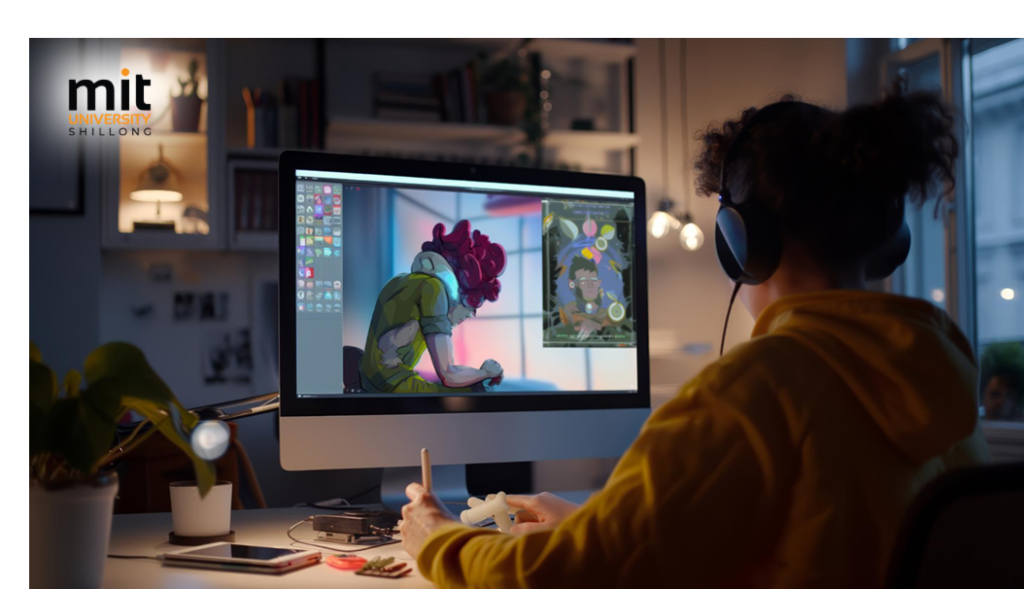
Animation brings static artwork to life by mastering movement mechanics, physical weight, and spatial timing. In professional studios, animators build visual sequences for feature films, television, commercials, visual effects, and medical simulations. Practitioners often specialise in 2D animation, 3D character performance, digital rigging, or scene lighting.
Enrolling in practical animation courses at leading animation design colleges, or a regional hub such as an accredited animation college in Assam, ensures you master tools like Maya and Blender. Learning standard studio pipelines helps you construct an industry-ready portfolio that attracts top global employers.
Understanding Game Design as a Career
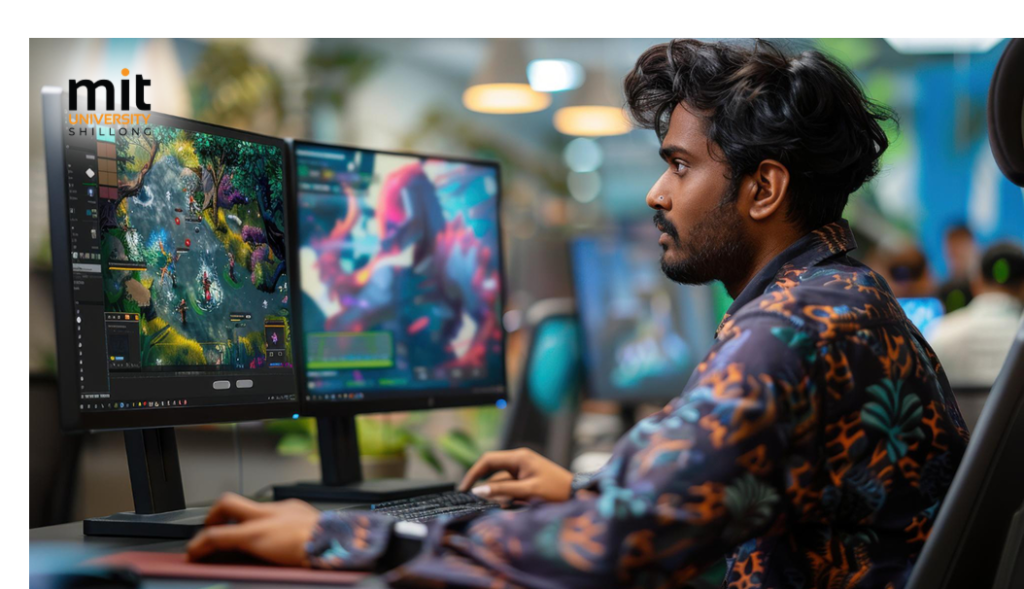
Game design crafts interactive systems, rules, level layouts, and gameplay mechanics. Working at the intersection of creative art, logic, and user psychology, game designers determine how mechanics operate, balance reward economies, and refine control responsiveness alongside programmers and artists.
Taking practical game design courses at a quality game design college provides hands-on experience with real-time engines like Unreal Engine 5 and Unity. Mastering these core tools helps you land high-demand game design jobs and build a sustainable game development career across global studios.
Animation vs Game Design – Key Differences
Below, we have outlined the core differences between these two creative disciplines to help you evaluate which direction fits your natural strengths.
| Factor | Animation | Game Design |
| Primary Focus | Linear narrative, body mechanics, visual emotion, and timing | System rules, player agency, level construction, and mechanics |
| User Interaction | Passive viewing where the outcome remains constant | Active participation where user input changes the outcome |
| Core Software Tools | Autodesk Maya, Blender, Cinema 4D, Toon Boom Harmony | Unreal Engine 5, Unity, Maya, Substance Painter, C#/C++ |
| Technical Requirement | Focuses on artistic theory, weight, and keyframing | Focuses on game balance, visual scripting, logic, and UI/UX |
| Coding Needed | Minimal coding required | Basic to intermediate scripting knowledge is preferred |
| Academic Pathways | Specialised training at animation design colleges | Hands-on degrees at an accredited game design college |
| Target Industries | Film, television, VFX, advertising, and architectural rendering | Video game studios, mobile games, AR/VR, and simulation software |
Skills Required for a Career in Animation
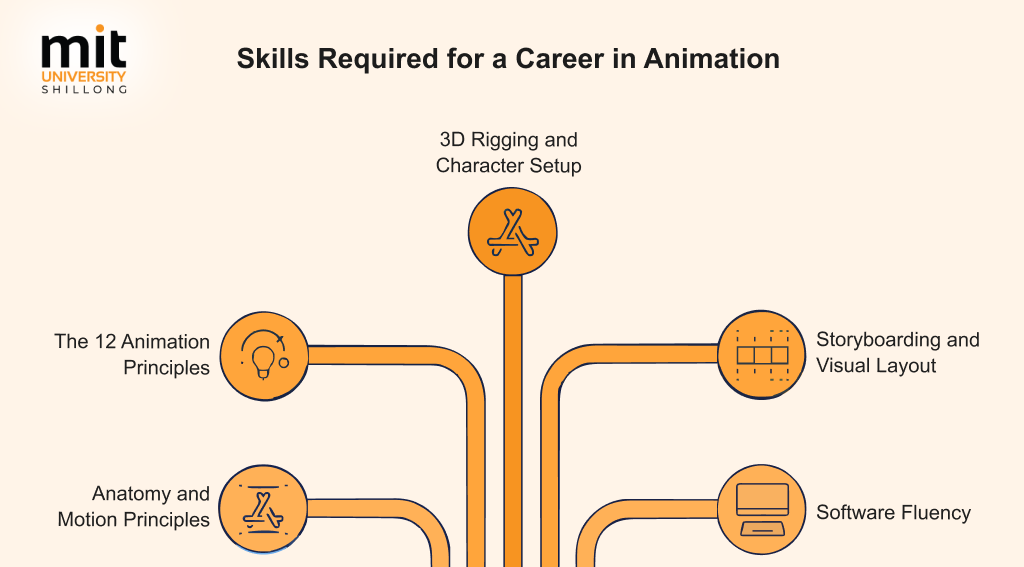
Working as a professional animator requires combining traditional artistic principles with technical execution. Essential skill sets include –
- Anatomy and Motion Principles – Understanding physical weight, balance, skeletal structure, and natural movement patterns across humans and animals.
- The 12 Animation Principles – Applying classic concepts like timing, squash and stretch, anticipation, staging, and follow-through to digital models.
- 3D Rigging and Character Setup – Understanding how skeletal joints and control handles work so 3D meshes move without visual distortion.
- Storyboarding and Visual Layout – Planning camera shots, focal points, and scene transitions before starting full production.
- Software Fluency – Mastering digital tools to execute smooth keyframing, rendering, lighting, and texture application.
Skills Required for a Career in Game Design
Succeeding in game design requires balancing creative imagination with structured logical thinking. Essential skill sets include –
- System Design and Game Mechanics – Crafting fair mathematical frameworks for character levelling, combat damage, health systems, and virtual economies.
- Engine Mastery – Navigating tools like Unreal Engine 5 or Unity to construct scenes, apply physics, and wire up interactive logic.
- Level Architecture – Planning spatial layouts that guide players naturally using lighting, visual landmarks, and subtle environmental cues.
- Visual Scripting and Prototyping – Assembling playable grey-box prototypes using node-based logic systems like Unreal Blueprints to test ideas quickly.
- Player Analytics and Playtesting – Interpreting user feedback and testing data to fix balancing issues and improve gameplay fluidity.
Educational Pathways for Animation and Game Design
A formal degree provides structured studio access, industry mentorship, and collaborative projects that self-study cannot replicate. Choosing institutions like MIT University India offers personalised pathways, custom electives, and 1-on-1 executive mentoring.
For students in East India researching a quality animation college in Assam or neighbouring regions, a top regional campus gives direct access to modern labs and industry links without distant relocation. Whether exploring leading animation design colleges, dedicated gaming animation colleges, or a reputed game design college, combining foundational art with real-world studio projects is essential. Apply early to secure 2026 merit scholarships now!
Career Opportunities and Industry Scope
There are many opportunities for both types of designers. Here are a few roles you can initially explore –
Primary Career Pathways in Animation
- Film & Television – Feature-length films, series production, character rigging, and storyboarding.
- Visual Effects (VFX) – CGI compositing, green-screen integration, and cinematic graphics for live-action media.
- Architectural & Medical Visualisation – 3D building walkthroughs, product prototyping, and anatomical models.
- Advertising & Digital Media – Motion graphics and digital campaigns for streaming platforms.
Primary Career Pathways in Game Design
- AAA & PC Game Studios – World-building, combat systems, and interactive mechanics driving high-demand game development careers.
- Mobile Game Companies – Gameplay loops, UI/UX design, and casual gaming experiences.
- AR/VR & Simulation – Interactive training environments for aviation, healthcare, and defence.
- Ed-Tech & Gamified Apps – Interactive reward systems that generate versatile game design jobs.
Industry Growth Statistics
The demand for skilled professionals in both domains is supported by recent industry data and reports.
- According to the FICCI-EY Media and Entertainment Report 2024, the Indian gaming industry reached ₹164 billion in 2023 and is projected to expand to ₹231 billion by 2026.
- This rapid expansion is generating steady demand for graduates equipped with practical skills from specialised game design courses.
- Official data from the Ministry of Information and Broadcasting (Government of India) shows that the domestic Animation, Visual Effects, Gaming, and Comics (AVGC) sector is growing at an annual rate of 16% to 18%.
- Government initiatives aim to capture a larger share of the global media market, creating over 2 million direct job roles over the next decade.
Salary and Career Growth Comparison
Salaries in both industries scale significantly as you build a strong portfolio, gain studio experience, and contribute to commercial releases.
| Career Stage | Animation Salary (LPA) | Game Design Salary (LPA) |
| Entry Level (0 to 2 Years) | ₹3.5 Lakhs to ₹6.0 Lakhs | ₹4.0 Lakhs to ₹7.0 Lakhs |
| Mid Level (3 to 6 Years) | ₹7.0 Lakhs to ₹14.0 Lakhs | ₹8.0 Lakhs to ₹16.0 Lakhs |
| Senior/Lead (7+ Years) | ₹16.0 Lakhs to ₹30.0 Lakhs+ | ₹18.0 Lakhs to ₹35.0 Lakhs+ |
| International Work | $55,000 to $95,000 USD | $65,000 to $120,000 USD |
Note – Salary ranges vary based on portfolio quality, technical engine skills, studio size, and geographic location.
Future Outlook for Animation and Game Design
The boundaries between traditional film production and video game development are disappearing. Tools like Unreal Engine 5 are now widely used in virtual film production, allowing directors to shoot live-action scenes inside real-time digital environments. At the same time, video games are featuring cinematic narrative structures that match feature films in visual quality.
Artificial intelligence tools are also entering studio pipelines, assisting artists with automated rigging, grey-boxing, and asset generation. Rather than replacing human creatives, these tools allow designers and animators to iterate faster, spending more time on high-level artistic decisions and unique gameplay systems. Universities like MIT train you in using AI to your advantage so you stay on top of the market trends. Explore their curriculum now!
Conclusion
Whether you decide to pursue animation or game design depends on what kind of creative work energises you most. It all depends on what type of storytelling you want to do and what makes you use your creativity to the full extent.
Choosing an established educational institution like MIT University India ensures you receive practical training, direct mentorship, and access to modern studio infrastructure. Get in touch with us now to take advantage of open admissions for the upcoming term to begin your professional career in the creative tech sector!
FAQs
Which career is better – animation or game design?
Both fields offer excellent career trajectories, solid earning potential, and creative fulfilment. Animation suits individuals who enjoy linear storytelling, and game design fits those interested in interactive systems.
Is coding required for a career in game design?
Deep programming expertise is not always mandatory for entry-level game designers, but having basic coding or visual scripting knowledge is extremely helpful.
Which field has better career growth – animation or game design?
Both industries show strong long-term growth, but game design currently experiences slightly higher commercial expansion due to the boom in mobile gaming, cloud platforms, and interactive digital media.
What skills are important for a career in animation?
Key skills for animators include drawing foundations, human and animal anatomy, spatial awareness, character performance study, and a strong understanding of timing and weight.
Can animation graduates work in the gaming industry?
Yes, animation graduates are regularly hired by game development studios. Modern video games rely heavily on character animators, 3D riggers, cinematic artists, and motion graphics. Completing degrees at recognised gaming animation colleges provides versatile skills that can be used in both fields.