


Is a UX/UI design course still valuable in the era of AI? The question looms in almost everyone’s minds. The truth, however, is reassuring. It is a great career choice, even now – especially now, because AI is evolving and human judgment is still a critical factor when it comes to creative pursuits.
This guide is for students, beginners, and anyone who wishes to break into the design industry. We’ll present you with facts on how to become a UX/UI designer, career options, and the current UX/UI designer salary.
What is UX/UI Design?
UX or User Experience design focuses on how a product feels. It maps the entire user journey, from the first click of the product to using it to complete the designated tasks. A UX designer researches user behaviour, designs the product flow, and removes unnecessary friction.
UI or User Interface design is all about how a product looks. It involves the technicalities and visual aspects of the product, including typography, colour, buttons, icons, spacing and how each element interacts with the user.
However, in practice, most roles expect you to know both. A UX/UI design course in India also caters to that need.
What skills are required to become a successful UI/UX designer?
Transitioning into UI/UX requires a blend of empathy and technical precision. You are no longer just designing for the eyes, but for the way a human mind navigates a digital product. Success in this field demands a mindset that prioritizes user friction over personal aesthetic preference. To become a successful UI UX designer, you must cultivate a specific set of core competencies, including but not limited to –
- User Research and Synthesis: You need the ability to conduct interviews and synthesize raw data into actionable insights. This prevents you from designing solutions for problems that do not actually exist.
- Information Architecture: Mastery in structuring content so that users can find exactly what they need with minimal cognitive load.
- Prototyping and Interaction Design: Beyond static mockups, you must understand how elements move and react when a user clicks or swipes.
- Visual Communication: Proficiency in design systems, typography, and color theory to ensure the interface is both accessible and brand-aligned.
- Collaborative Logic: The skill to communicate your design decisions clearly to developers, ensuring your vision survives the handoff process.
Why UX/UI Is a Great Career Choice?
Brands that once competed for price and features now compete for user experience, be it immersive or otherwise. And for that, an intuitive interface plays a critical role.

That’s why the demand for UX/UI designers will far exceed expectations:
- The demand for AI-driven products has given way to new design roles such as product thinking, research, and systems design.
- Industries like Healthcare, Education, Retail, Finance. Logistics and Real Estate are adopting digital-first models, so there is an aggressive need for such designers.
- It’s the startup era now. And they need UI/UX principles to launch quickly, improve product adoption and reduce churn.
Choosing a UX design college in India will teach the basic principles of UX/UI design and also provide the required industry exposure to kickstart a career in that field. Leading institutions, especially MIT Shillong, offer design programmes that are both experiential and theoretical.
Important UX/UI Skills Needed for Students in 2026
As stated earlier, it is the AI-assisted design generation. Students should understand AI, basic Data Analytics, strategic problem designing, and advanced prototyping. MIT Shillong’s School of Design has specific undergraduate and postgraduate courses on UX/UI that propagate the following skills:
| Skill Category | Description |
| AI Tool Integration | Use AI to automate repetitive tasks, such as auto-layering, layout generation, and rapid wireframing. |
| Data Synthesis | Conduct basic surveys, analyse user transcripts, test data with AI tools, and extract actionable insights quickly. |
| System Design | Design thinking that involves connected design systems and component libraries within the product. |
| Functional Prototyping | Create high-fidelity, interactive prototypes in Figma that mimic a coded product, including basic CSS or vibe coding awareness. |
| Design-to-Code Handoff | Understand and execute modern handoff workflows so developers can easily implement your designs. |
| Information Architecture (IA) | Structure intuitive sitemaps and content hierarchies so users navigate complex digital products without friction. |
| Usability Testing & Empathy | Plan unbiased research studies, map user flows, and iterate designs based on observed behaviour. |
| Interface Fundamentals | Apply UI design principles to create trustworthy, visually coherent products. |
| Motion Design | Add micro-interactions and deliberate transitions that improve the overall feel and intuitiveness of an interface. |
The top UI/UX colleges in India now ingrain AI literacy and systems thinking to enhance a UX/UI designer’s performance.
Best Beginner UX/UI Design Tools
We list the best tools recommended by every designer:
| Tool | Purpose |
| Figma | Industry standard for UI design and collaborative prototyping |
| Adobe XD | Wireframing, prototyping, and handoff |
| Maze / Useberry | Usability testing and user research |
| Miro | User journey mapping and brainstorming |
| Notion / FigJam | Documentation and design sprint facilitation |
How Much Can You Earn As A UX Designer?
The UI/UX designer salary depends on how much research skills, systems thinking, and business acumen students display, in addition to visual craft
| Experience Level | Annual Salary Range | Monthly Estimate |
| Fresher (0–2 years) | ₹2.5 – 4 LPA | ₹35,000 – ₹40,000 |
| Mid-Level (3–5 years) | ₹7.4 – 9.5 LPA | ₹62,000 – ₹79,000 |
| Senior (5–10 years) | ₹12 – 25 LPA | ₹1,00,000 – ₹2,08,000 |
| Expert (10+ years) | ₹15 – 56 LPA | ₹1,25,000 – ₹4,67,000 |
What is the UX/UI Design Process
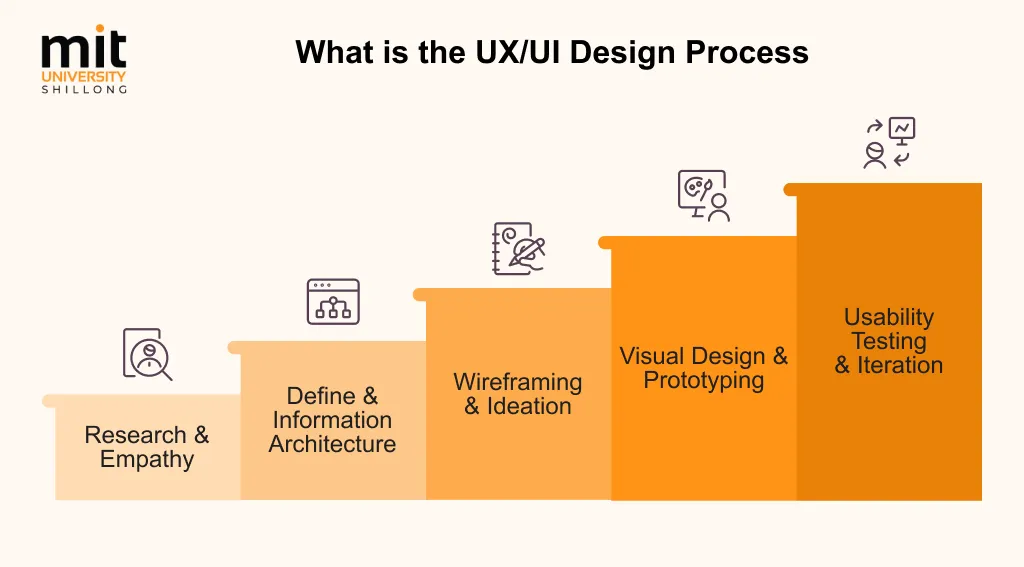
The UX/UI process is non-linear and includes:
1. Research & Empathy
Conduct user interviews, run competitive analysis, and create research-backed personas.
2. Define & Information Architecture
Convert research into a problem statement. Map user flows and organise the product’s navigation structure and content hierarchy, and decide what the product does before deciding how it looks.
3. Wireframing & Ideation
Start with rough sketches to quickly explore multiple layouts. Produce mid-fidelity wireframes in Figma, such as black-and-white layouts that validate structure.
4. Visual Design & Prototyping
Apply typography, spacing, UI components, and a colour system. Use the 60-30-10 rule as a starting point. Polish screens to high fidelity, then link them in Figma Prototyping to simulate the real product experience.
5. Usability Testing & Iteration
Put prototypes in front of real users. Observe where they hesitate or fail, collect data via tools like Maze, and revise. Continue the cycle until the design solves the original problem, and then hand it off to the developer.
How to Build a Standout Portfolio
- Describe 3–5 case studies that talk about your thought process, tools used, and how you framed your problem statement.
- Break your project into sections. It should have an objective, a problem statement, a brief description of the project, a timeline, and the result.
- Include Wireframes alongside final screens, so hiring managers can understand your thinking process, ideas, and execution style.
- You can either design an actual app or rework an existing one. Pick an app with a known usability problem and fix it. It adds value and credibility to your work.
- Host your portfolio on professional platforms. Use Behance, Notion, or a personal site to exhibit all your design work.
Every UX/UI Career Path Explained
MIT Shillong’s Bachelor of Design (B.Des) in User Experience Design helps you understand basic concepts, work with hands-on problems, and build a remarkable portfolio. Once you complete the course, you can choose from multiple UX/UI designer jobs:
- UX Researcher
- UI Designer.
- Product Designer
- UX Writer
- Interaction designer
- Design Manager / Head of Design
Final Thoughts
UX/UI design is for people who love to understand how others think and feel. If you are looking for a great start, choose a programme at a UI/UX college in India that offers studio-based learning, industry mentors, and a portfolio-first approach.
Ready to take the first step? Explore MIT Shillong’s UX/UI design courses and build your design career now.
FAQs
1. Is UX/UI design a good career for beginners?
Yes. It is easier to get into designing than engineering or law, and the demand for entry-level designers is high. A UX/UI design course and a good portfolio are enough to land your first role.
2. Is a degree necessary for a UX/UI career?
Yes. A formal degree from a recognised UX design college in India adds credibility, provides mentorship, and improves learning.
3. Can freshers get jobs in UX/UI design?
Yes. Freshers with a reputable portfolio and at least one case study to prove their design process get hired quickly for junior or entry-level roles. If they interned or freelanced, it adds to their experience.
4. What is the difference between UX and UI design?
UX focuses on the overall journey and usability of a product. UI focuses on the visual and interactive elements of the product. Both are essential, and most roles today require fluency in both.
5. Why is UX/UI design becoming popular?
All digital products, such as apps, websites, dashboards, or kiosks, need a designer to improve the product, user retention and revenue, making UX/UI designer jobs the most sought-after.