

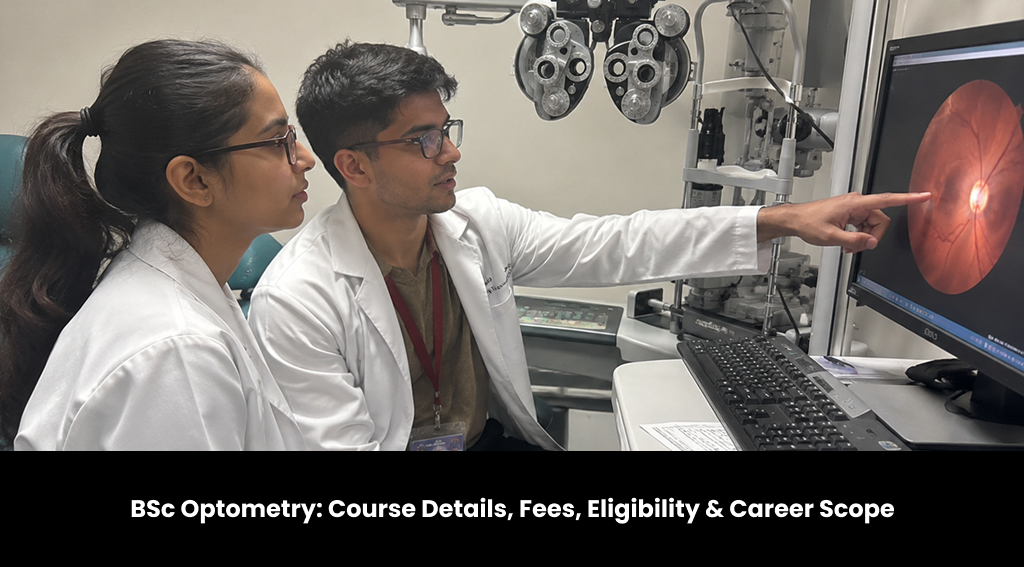
The BSc in Optometry is a four-year undergraduate programme that trains students to diagnose vision disorders, prescribe corrective lenses, and provide clinical support to ophthalmologists. You can pursue an optometry course after 12th if you chose Physics, Chemistry, and Biology as your primary subjects. At the end of the undergraduate programme, you can work in hospitals, research institutions, retail eye care centres, and even set up your own private practice.
BSc Optometry: An Overview
Eye care is one of the fastest-growing sectors within healthcare. India is home to more than 20% of the world’s visually impaired population. Yet, a detailed AIIMS survey found only 17,849 optometrists at secondary and tertiary levels, with an optometrist-to-ophthalmologist ratio of 0.85, far below the Vision 2020 target of three paramedics per ophthalmologist.
A complete BSc Optometry course can help bridge that abysmal gap. The programme enables students to diagnose, manage, and treat a wide range of visual and eye-related conditions in close coordination with ophthalmologists and healthcare professionals. It is offered across India under different titles: BSc Optometry, B.Optom, or Bachelor of Optometry, and equips graduates with adequate medical knowledge and hands-on patient care skills.
MIT University, Shillong, offers the BSc (Hons) in Optometry under a proven academic model to Northeast India. The programme is UGC recognised and approved by the Government of Meghalaya.
What specialisations are available in B.Sc. programmes?
Specialisation allows students to move beyond the general curriculum, focusing on specific branches of healthcare that require deep technical knowledge. Choosing a distinct track ensures you gain the targeted expertise needed to handle complex patient cases, making you a highly sought-after professional in clinical and research settings.
The healthcare sector in India is expanding, with a critical need for focused expertise. Within this particular a B.Sc. framework, you can pursue specialisations such as:
- Binocular Vision and Orthoptics: Focusing on the treatment of eye alignment issues and coordination, which is essential for pediatric and rehabilitative care.
- Contact Lens and Ocular Prosthetics: A highly technical specialisation that involves fitting complex lenses for irregular corneas and managing ocular comfort for sensitive patients.
- Low Vision Rehabilitation: Dedicated to enhancing the quality of life for patients with permanent vision impairment through specialized optical aids and training.
- Geriatric Optometry: Addressing the unique ocular health challenges faced by the aging population, a growing segment in the current healthcare landscape.
- Occupational Optometry: Analyzing visual performance in work environments to prevent strain and injury in high-demand industrial settings.
Eligibility Criteria for BSc Optometry
The eligibility requirements for BSc Optometry at MIT University, Shillong are:
- Should have chosen the 10+2 in the Science stream with Physics, Chemistry, and Biology as core subjects.
- Should have secured a minimum of 50% aggregate marks for general category applicants and 45% for students from reserved categories.
- Should have demonstrated ability in basic understanding of and communication in English.
- Should have the fundamental knowledge of medical science.
- If you appeared in any entrance exams, you should have a valid score to show for them.
Students awaiting their Class 12 results may also apply to several institutions, with admission confirmed upon the declaration of results.
Optometry Course Duration and Structure
The optometry course duration at MIT University, Shillong, is 4 years, including a 24-month internship.
The four years are organised into three distinct phases.
| Year | Subjects |
| Years 1 & 2 | ocular anatomy, physiology, optics, and visual science |
| Year 3 | clinical optometry, contact lens practice, low-vision care, and pharmacology |
| Year 4 | 24-month integrated internship in eye hospitals, clinics, and vision centres for full-time clinical work. |
Entrance Exam for Optometry Admission
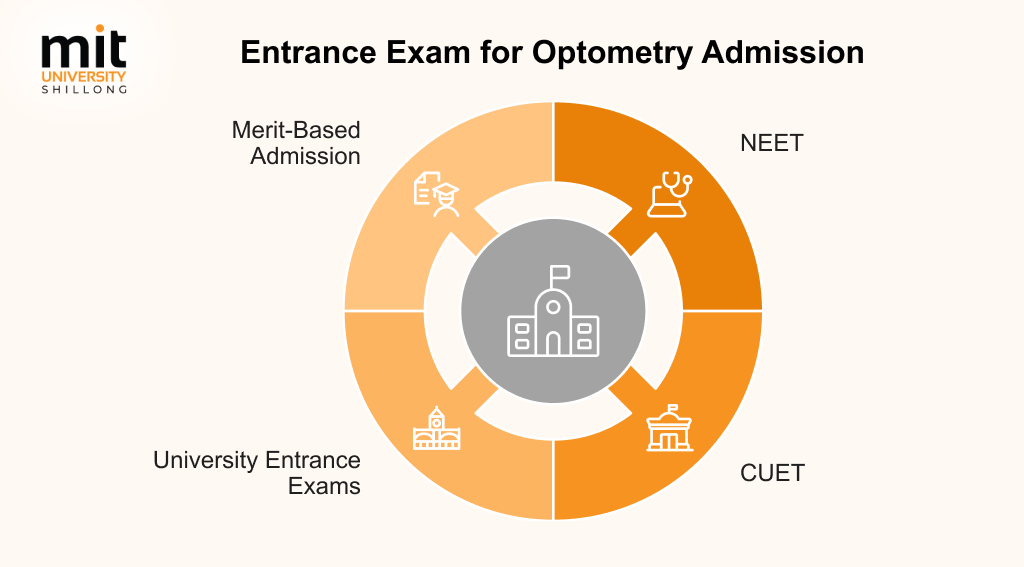
Admission to BSc Optometry varies by institution. Some institutes require candidates to pass entrance exams, and some admit students based on Class 12 merit.
Commonly accepted entrance exams for optometry include:
- NEET is accepted at a few select medical and paramedical institutions, although it is not mandatory for optometry courses in India.
- CUET is recognised by central universities and affiliated institutions
- University entrance exams are conducted independently by institutions
- Merit-based admission is applicable at many private universities
BSc Optometry Syllabus and Subjects
The BSc Optometry syllabus at MIT University, Shillong, includes both theoretical and applied components of eye care.
As outlined in the programme, students receive:
- In-depth study of ocular anatomy, optical science, and vision care principles
- Hands-on training in lens prescription, contact lens fitting, and ocular disease management
- Proficiency in operating diagnostic and optometric instruments used in clinical practice
- Application of preventive eye health protocols and vision therapy methods
- Patient communication training, including ethical practices in vision care
Mandatory academic subjects include:
- Ocular Anatomy and Physiology
- Optometric Optics and Visual Optics
- Refraction and Prescribing
- Contact Lens Theory and Practice
- Binocular Vision and Orthoptics
- Ocular Pharmacology
- Low Vision Rehabilitation
- Paediatric Optometry
- Ocular Disease and Pathology
- Community Eye Health and Public Health Ophthalmology
- Clinical Methods and Instrumentation
Clinical Training and Practical Exposure

During the final semesters, each student is assigned to a hospital or optical centre as a clinical intern, gaining hands-on experience and documenting their learning in a logbook that serves as the basis for their final assessment.
- Students work directly with optometric instruments, contact lenses, and low-vision aids during supervised clinical sessions.
- They train in eye clinics, hospitals, and optical centres.
- Students carry out community eye health projects, extending their work beyond the clinical environment to serve broader populations.
- They complete semester-long and year-long internships in hospitals, eye clinics, and optical centres.
BSc Optometry Fees in India
BSc Optometry fees in India range from ₹25,000 to ₹3 lakh per year, depending on the institution. Government colleges typically charge ₹25,000 to ₹80,000 per year, while private colleges charge ₹1 lakh to ₹3 lakh per year.
A general fee comparison based on institution types includes:
| Institution Type | Fee Structure |
| Government/State Universities | ₹25,000 – ₹80,000 |
| Private Universities in Tier-2 cities | ₹80,000 – ₹1.5 lakh |
| Private Universities in Metro cities | ₹1.5 lakh – ₹3 lakh |
| MIT University, Shillong | ₹1.20 lakh |
MIT University, Shillong, offers different scholarship programmes for deserving candidates, including merit-based and category-based financial support. International students are automatically assessed for multiyear scholarships upon application. Students from Northeast India may additionally qualify for state-sponsored financial aid schemes.
BSc Optometry in Assam: Colleges and Scope
A BSc in Optometry in Assam is highly relevant to paramedic careers, given the region’s documented shortage of eye care professionals.
MIT University, Shillong, is the most accessible option for students across the Northeast. Its campus in Umroh, Mawkasiang Village, is reachable by air via Shillong Airport and by train to Guwahati, with road connectivity from Assam and neighbouring states.
Other institutions offering optometry programmes in and near Assam include:
- Assam Downtown University (ADTU) in Guwahati offers a Bachelor of Optometry program with clinical exposure.
- Sri Sankaradeva Nethralaya School of Optometry, Guwahati, is affiliated with Srimanta Sankaradeva University of Health Sciences, Assam.
- Kaziranga University, Jorhat, offers B.Optom with structured clinical training.
Career Opportunities After BSc Optometry
Graduates with a BSc Optometry can work in eye hospitals, optical retail chains, eye clinics, contact lens companies, and research centres.
Key employment sectors include:
- Public sector: Government hospitals, AIIMS, district health centres, NPCB-linked programmes
- Private hospitals: Apollo, Fortis, Dr Agarwal’s Eye Hospital, Vasan Eye Care, Aravind Eye Hospital
- Optical retail: Lenskart, Titan Eye+, GKB Opticals, Himalaya Optical
- Medical device companies: Carl Zeiss, Bausch & Lomb, Alcon, Essilor
- NGO and community eye health programmes
- Teaching and research in optometry institutions
Job Opportunities for Optometrists
The BSc Optometry jobs include:
| Job Role | Job Description |
| Clinical Optometrist | performs eye tests, diagnoses refractive errors, and prescribes lenses |
| Contact Lens Specialist | fits and manages therapeutic and cosmetic contact lenses |
| Low Vision Specialist | works with patients experiencing partial vision loss |
| Paediatric Optometrist | manages children’s eye conditions, including amblyopia and squint |
| Ophthalmic Assistant | supports surgeons in pre- and post-operative care |
| Vision Therapist | provides treatment for binocular vision disorders |
| Optical Sales Executive | advises customers in optical retail settings |
| Academic / Research Optometrist | teaches or conducts vision science research |
Salary Trends and Growth Opportunities
Fresh graduates can earn an average salary of ₹5-₹6 lakhs annually. With experience and specialisation in ocular disease, annual income can reach ₹10–12 lakhs.
You can get higher salary packages depending on your expertise, experience, where you are located, and the industry you are placed in. Optometrists at AIIMS, LV Prasad Eye Institute, or large optical chains command higher packages. Those who pursue postgraduate qualifications, M.Optom, M.Sc. in Vision Science, or an MBA in Healthcare Management, gain senior clinical, academic, and administrative roles.
Benefits of Choosing a Career in Optometry
- Job security: India currently has far fewer optometrists than are needed to meet Vision 2020 targets, meaning demand for qualified professionals will remain high for the foreseeable future.
- Multifarious roles: You can enter multiple sectors, such as clinical research, retail, teaching, and public health, for varied experience.
- Rapid growth: Optometry is India’s fastest-growing healthcare profession, due to rising screen time, the prevalence of refractive errors, and an ageing population.
- Social impact: Optometrists have a social responsibility as they play a crucial role in preventing avoidable blindness.
- Advancement options: Access to postgraduate study, specialisation, private practice, and international opportunities.
Frequently Asked Questions
- Is a BSc Optometry a doctor?
An optometrist is a primary eye care professional, whereas an ophthalmologist is a doctor specialised in eye surgeries. Optometrists are qualified to examine eyes, diagnose vision disorders, and prescribe corrective lenses. BSc Optometry is recognised as an allied health science, and optometrists usually assist ophthalmologists in hospitals.
- What is the highest optometrist salary?
In India, senior optometrists and specialists earn anywhere between ₹7 lakhs and ₹12 lakhs annually. Private practitioners earn more than ₹1 lakh per month, depending on skill and experience. Fresh graduates start at ₹15,000 to ₹33,000 per month. Once they gain experience and specialised capabilities, they can quickly move up the ladder. securing better compensation.
- Will Optometry get replaced by AI?
Although AI is increasingly used in eye care for image analysis and disease screening, it does not replace an optometrist’s clinical judgment, patient communication, and hands-on examination.
Optometrists remain essential, especially for verifying AI-based decisions and ensuring patients receive the right prescriptions.
- Which is better — BSc Optometry or BPT?
Both are allied health science careers with solid employment prospects. BSc Optometry focuses on eye care, vision science, and ocular diagnosis. BPT covers musculoskeletal and neurological rehabilitation. The choice depends on your interests; if eye care and vision science appeal to you, optometry offers a more specialised, in-demand career path.
- Does Optometry have placements?
Yes. MIT University, Shillong, provides placement support through a common placement network with MIT Pune, connecting graduates with hospitals, optical chains, eye care institutions, and healthcare companies. Top recruiters include Lenskart, Titan Eye+, Dr Agarwal’s Eye Hospital, Vasan Eye Care, and Apollo Hospitals. Graduates with good clinical training and internship records consistently secure employment before or shortly after completing their degree.