

Choosing the right school for film making courses can shape your first few years in the industry. If you want to work in direction, camera, editing, or production, the right school should give you structured training, live projects, equipment access, faculty support, and career-facing exposure from the first year.
That choice is essential now because the screen business is expanding across cinema, streaming, branded content, short video, and digital storytelling. Industry forecasts show that India’s media and entertainment sector reached ₹2.78 trillion in 2025 and is expected to touch ₹3.3 trillion by 2028, while India’s creator economy already includes 2 to 2.5 million active digital creators.
How Should You Choose A Film School Based On Your Specialisation?
Do not start with the campus. Start with the craft.
Students often search for film making courses and apply without deciding whether they want direction, cinematography, editing, production design, screenwriting, or post-production. That creates confusion later. A film school should help you focus early and build range after that.
India’s workforce is projected to grow from 423.73 million in 2023 to 457.62 million by 2028, a net gain of nearly 34 million workers, with education adding about 0.84 million jobs, according to research commissioned by ServiceNow from Pearson. Digital transformation is reshaping these roles, which means creative graduates who build technical fluency alongside craft are well placed for evolving media careers.
If you enjoy visual framing, camera movement, and lighting, look closely at cinematography courses. If you like narrative rhythm, cuts, pacing, sound-image balance, and post work, compare film editing courses first. If you prefer planning, crew management, budgeting, and execution, review film production courses with care.
What Types Of Film Making Courses Should You Explore?
Film education is not one lane. Good schools usually build a broader base before students move into a sharper area.
You should compare:
- film making courses for direction, storytelling, production grammar, and set practice
- film production courses for budgeting, scheduling, coordination, and project execution
- cinematography courses for camera language, lighting, lenses, and shot composition
- film editing courses for post-production, timing, continuity, sound sync, and software workflows
- interdisciplinary creative arts education for visual culture, performance, writing, and design thinking
A strong school does not isolate these areas too early. It lets students see how one role affects the other.
What Should You Check In The Admission Process And Requirements?
Admissions tell you a lot about the school’s seriousness.
A strong film school usually checks:
- academic eligibility
- creative interest
- portfolio or statement of purpose
- interview performance
- visual awareness or storytelling potential
At MIT University Meghalaya, we guide students through admissions with a structured process and student-facing support, so applicants know what to prepare and where they stand.
Why Do Practical Training And Equipment Matter So Much?
Film is a practice-led field. Students do not become employable through theory alone.
Before you compare schools, it helps to see where real value comes from.
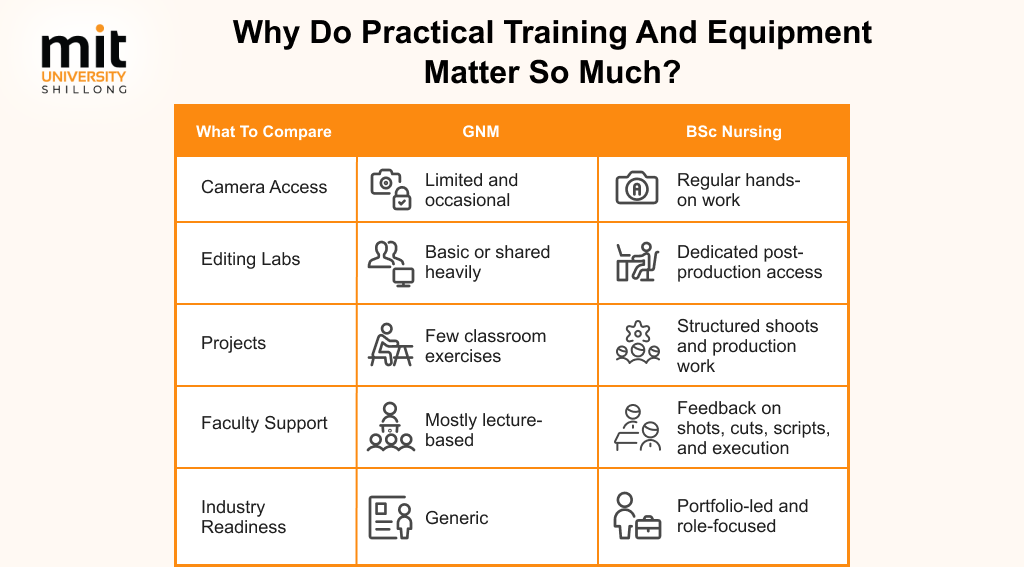
| What To Compare | Weak Setup | Strong Setup |
| Camera Access | Limited and occasional | Regular hands-on work |
| Editing Labs | Basic or shared heavily | Dedicated post-production access |
| Projects | Few classroom exercises | Structured shoots and production work |
| Faculty Support | Mostly lecture-based | Feedback on shots, cuts, scripts, and execution |
| Industry Readiness | Generic | Portfolio-led and role-focused |
This is where many decisions go wrong. Students look at branding and ignore infrastructure. In film education, access changes skill growth. If you cannot shoot, edit, review, and reshoot, you will struggle to improve.
Film School Vs Self-Learning: Which Is Better?
Self-learning can help, but it is not a full substitute for a good film school.
You can learn editing software online. You can watch shot breakdowns. You can study film history alone. But structured school-based training gives you deadlines, critique, equipment access, team practice, and a disciplined production environment. That combination is difficult to build on your own.
Self-learning works best as a supplement. Film school gives you process, rigour, and a peer ecosystem. That is why serious students still choose structured film making courses and film editing courses when they want long-term growth.
How Should You Compare Film Schools Before Applying?
Use a shortlist, not guesswork.
Compare each school on:
- specialisation fit
- faculty profile
- production infrastructure
- editing and camera access
- internship support
- student films and portfolios
- fee value
- location and industry exposure
If one school looks good on paper but weak in practice, remove it. If another school has strong practical exposure and a better learning structure, move it up the list.
Why Should Students Choose A B.Des Course For A Creative Career?
A creative degree gives students structured training and a portfolio that translates directly into a fast-expanding screen and design economy. The strongest reasons include:
- Hands-on skill building across camera, editing, production, and design workflows
- A portfolio and peer network that employers assess ahead of marks
- Exposure to OTT, branded content, and digital storytelling formats from year one
This is essential because the industry absorbing these graduates is growing quickly. India’s media and entertainment sector reached ₹2.78 trillion in 2025 and is expected to touch ₹3.3 trillion by 2028, while the creator economy already includes 2 to 2.5 million active digital creators.
That expansion widens the range of paid creative roles, which means a structured course positions students to enter production and content careers with real, demonstrable craft.
What Career Opportunities Open Up After Film School?
Film school can lead to multiple paths, not just one title.
Common roles include:
- assistant director
- cinematographer
- editor
- camera assistant
- production assistant
- script supervisor
- post-production executive
- content producer
- media professional across digital and OTT formats
That is where creative arts education helps. It gives students wider creative range and stronger adaptability across changing media formats.
Final Thoughts
The right film school does not just teach software or camera basics. It shapes your craft, your work ethic, your portfolio, and your first entry into the industry.
At MIT University Meghalaya, we believe film education should stay practical, collaborative, and career-facing. We support students through guided learning, creative development, and exposure that connects the classroom with real production expectations. If you want to build a serious career in film, now is the right time to compare your options and apply with a clear goal.
FAQs
What is the hardest film school to get into?
Usually the most selective schools ask for strong portfolios, interviews, and creative clarity, not just marks. Difficulty depends on seat count and applicant quality.
Is cinema dying or evolving?
Cinema is evolving. The industry now extends across theatres, OTT, branded video, short-form content, and hybrid digital storytelling formats.
What exactly is film school?
Film school is structured professional training in direction, camera, editing, production, writing, and screen storytelling through theory, projects, critique, and practical work.
Can I join a film institute after 12th?
Yes. Many students join film institutes after Class 12 through undergraduate courses, diploma programmes, or creative entrance-based admissions.
What is the highest paid job in film?
Pay varies by scale and experience, but direction, cinematography, editing leadership, and production leadership can reach the higher end.
What age is film school for?
There is no fixed age rule in principle. Most students join after 12th or graduation, depending on course level and eligibility.