

Introduction
In the modern job market, marks alone are not enough to build a meaningful career. Plus, Companies today look for graduates who can communicate confidently, work in teams, understand problems deeply, and behave professionally in challenging situations.
This is why soft skills education, soft skills training, and soft skills for students have become essential parts of higher education. These skills decide how well a student adjusts to the workplace, interacts with colleagues, and grows in the long term.
Key Statistics on Soft Skills Importance:
- According to a recent report from the Ministry of Skill Development & Entrepreneurship, 2024 revealed that nearly 89% of hiring managers believe strong soft skills are more important than technical skills for long-term success
- Another major survey in 2024, supported by AICTE employability studies, found that 78% of Indian recruiters reject candidates due to weak communication, lack of confidence, and poor teamwork abilities, even when the applicants have good academic results
- These facts, further validated by NITI Aayog’s education reports, make it clear that soft skills are now a core requirement for every student hoping to enter the corporate world
Shillong as an Emerging Education Hub:
- Cities like Shillong are emerging as promising education hubs where students receive both academic learning and personality development
- Colleges in the region, especially respected institutions like MIT University Shillong, are among the best colleges in Meghalaya
- Often ranked as the best college in Shillong, focusing heavily on preparing learners for corporate life through structured skill-building programmes
Table of Contents
- Getting Started
- What Are Soft Skills and Why Do They Matter for Students?
- Soft Skills and the Changing Nature of Work
- Role of Higher Education Institutions in Soft Skills Development
- Spotlight on MIT University Shillong – A Model for Corporate Readiness
- Key Soft Skills Students Should Cultivate
- Communication
- Problem-Solving & Critical Thinking
- Adaptability & Flexibility
- Emotional Intelligence & Empathy
- Leadership & Initiative
- Time Management & Professionalism
- Communication
- How Soft Skills Education in Shillong Adds Unique Value
- Challenges & How Institutions Can Address Them
- Conclusion
- FAQs
Getting Started
Soft skills are becoming a powerful part of professional success. While technical knowledge helps students understand their subjects, soft skills help them apply this knowledge effectively in real-life situations.
These skills decide how well a person works with others, reacts to pressure, presents ideas, and adapts to change.
In regions like Shillong, known for peaceful surroundings and strong academic culture, universities are giving students the perfect space to practise and develop these qualities.
This balance between learning and personality development is shaping students into capable, confident future professionals.
What Are Soft Skills and Why Do They Matter for Students?

Soft skills are personal qualities, communication habits, emotional strengths, and behavioural skills that help students manage situations smoothly and interact politely with others. These skills help in every academic and corporate environment.
Why are soft skills important for students?
These are important because they help students become confident speakers, good team players, thoughtful problem-solvers, and responsible future employees.
Examples of important soft skills:
- Public speaking and clear communication
- Listening politely
- Working in teams
- Staying calm under pressure
- Creative thinking
- Showing leadership when needed
- Respecting deadlines
- Expressing empathy
- Managing time well
- Professional behaviour
There are many students who do not realise how important these skills are until they attend interviews or internships. Recruiters appreciate students who can express their thoughts, give solutions, and collaborate well with others. This is why soft skills training must begin early.
Soft Skills and the Changing Nature of Work

The corporate world is changing quickly. Digital tools, remote working, artificial intelligence, and automation have transformed how companies function. Employees now need more than book knowledge to keep up with these changes.
How is work changing today?
- Teams work across cities and sometimes across countries.
- Communication happens mostly online.
- New software and systems are introduced regularly.
- Workplaces prefer flexible and adaptable employees.
- Companies want people who can solve new problems creatively.
According to the World Economic Forum report (2023) shared that by 2030, the most valuable skills will be communication, critical thinking, creativity, adaptability, and emotional intelligence. These are all soft skills and not the technical ones. This shows that the future belongs to students who can think well, speak confidently, and understand people deeply.
Role of Higher Education Institutions in Soft Skills Development
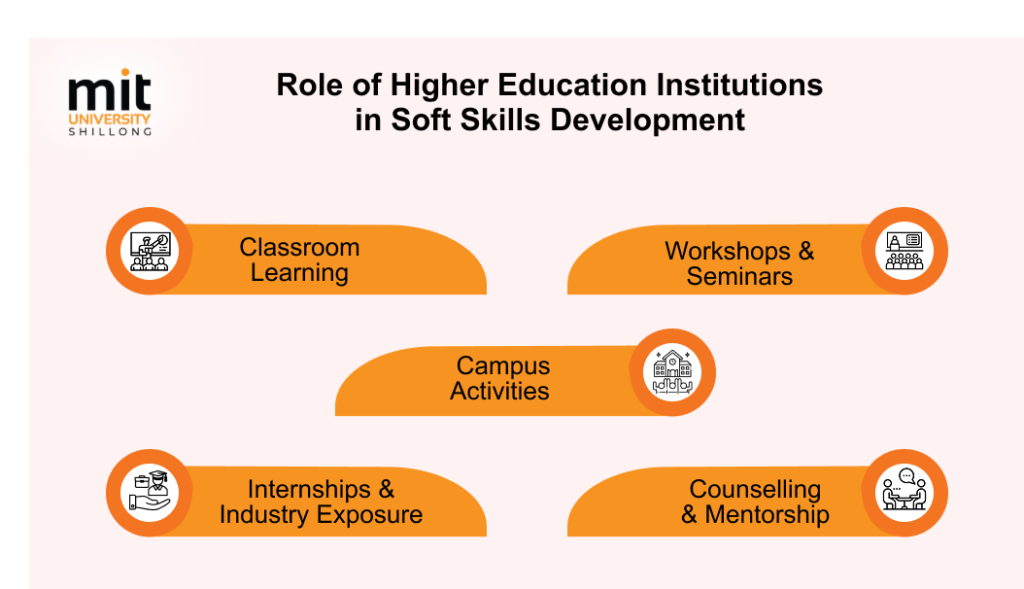
Colleges and universities play a major role in shaping a student’s personality. Good institutions now understand that education is not only about lessons, assignments, and exams. It should build confidence, communication strength, and emotional maturity.
How do universities help develop soft skills?
1. Classroom Learning
Teachers include presentations, group tasks, debates, and discussions so students practise communication and teamwork naturally.
2. Workshops & Seminars
Professional trainers conduct sessions on leadership, presentation skills, body language, creative thinking, and interview performance.
3. Campus Activities
Cultural clubs, sports, and student societies help learners develop teamwork, confidence, and decision-making.
4. Internships & Industry Exposure
Internships help students understand workplace rules, etiquette, and teamwork.
5. Counselling & Mentorship
Mentorship strengthens emotional intelligence, problem-solving skills, and clarity of thought.
Why does this matter?
A university that focuses on soft skills education produces graduates who are emotionally strong, professionally mature, and ready for the real world.
Spotlight on MIT University Shillong – A Model for Soft Skills & Corporate Readiness
MIT University Shillong is regarded as one of the best colleges in Meghalaya and is often recognised as the best college in Shillong because of its focus on overall student development. The university follows a learning model where academic understanding and personality growth move together.
The institution treats soft skills education, soft skills training, and soft skills for students as essential components of its curriculum. Instead of teaching soft skills as a separate theory subject, MIT Shillong blends them into regular activities, classes, and projects so that students learn naturally and consistently.
MIT Shillong’s approach includes:
- Communication Platforms: Presentations, debates, theatre activities, group discussions, and student-led events.
- Industry Workshops: Sessions led by corporate experts to build teamwork, adaptability, innovation, and leadership.
- Modern Teaching Methods: Collaborative classrooms, project-based learning, and peer evaluations to improve confidence.
- Placement Training: Resume writing, email etiquette, interview practice, corporate ethics, and personality grooming.
- Real-World Exposure: Internships and live projects that teach responsibility and professional discipline.
- Community Engagement: Social initiatives that develop empathy, emotional intelligence, and cultural respect.
With this balance of academic strength and personality development, students graduate as confident, job-ready individuals.
Key Soft Skills Students Should Cultivate for Corporate Success
1. Communication
Why is communication essential for students?
Because it helps in interviews, group work, presentations, meetings, and workplace relationships.
What strong communication looks like:
- Clear speaking
- Listening without interrupting
- Writing correctly
- Confident presentations
- Professional emails
- Polite tone and respectful behaviour
2. Problem-Solving & Critical Thinking
Why do companies value this skill?
Modern workplaces face unexpected problems that need quick and logical solutions.
How students can build this skill:
- Participate in brainstorming tasks
- Analyse case studies
- Challenge ideas respectfully
- Look for patterns and reasons
- Think of practical solutions
3. Adaptability & Flexibility
Why is adaptability important?
The work world changes constantly, like new software, new rules, and new responsibilities. Companies prefer employees who adjust calmly.
Signs of an adaptable student:
- Learns new tools quickly
- Handles changes without stress
- Open to new ways of working
- Responds positively to challenges
4. Emotional Intelligence & Empathy
Why does emotional intelligence matter?
Because workplaces require people who handle conflict, understand emotions, and maintain healthy relationships.
Ways students show emotional intelligence:
- Staying calm under pressure
- Listening to others’ feelings
- Handling disagreements politely
- Supporting teammates
- Showing kindness and respect
5. Leadership & Initiative
Why is leadership important for students?
Even in college, leadership helps in group projects, events, and campus responsibilities.
Leadership qualities include:
- Guiding the team
- Taking responsibility
- Motivating others
- Making fair decisions
- Showing confidence
6. Time Management & Professionalism
Why does time management matter?
Because corporate life runs on deadlines, punctuality, and discipline.
Student habits that show professionalism:
- Completing work on time
- Following schedules
- Prioritising tasks
- Organising notes and assignments
- Dressing neatly for formal events
How Soft Skills Education in Shillong Adds Unique Value
Shillong has a unique learning atmosphere. Its peaceful environment, cultural diversity, and strong academic community create the perfect space for students to learn confidently.
What makes Shillong special for soft skills?
- Calm surroundings that reduce stress
- Teachers who focus on personalised education
- Exposure to multicultural interactions
- Colleges that balance academics with practical learning
- Opportunities for community involvement
- Institutions like MIT University, Shillong setting high standards
The overall environment supports growth, confidence, discipline, and emotional maturity.
Challenges & How Institutions Can Address Them
1. Students may feel shy speaking publicly
Solution: More presentations, debates, and small speaking tasks.
2. Lack of confidence in English communication
Solution: Language labs, speaking clubs, and guided practice.
3. Limited industry exposure
Solution: Internships, company visits, and expert workshops.
4. Pressure and stress
Solution: Counselling, emotional support, time-management training.
5. Difficulty adapting to changes
Solution: Research tasks, digital skill training, and flexible learning activities.
Conclusion
Soft skills are no longer optional. They shape a student’s entire future—how they communicate, lead, solve problems, handle challenges, and work with others. Through strong soft skills education, regular soft skills training, and early focus on soft skills for students, colleges can prepare young people for real corporate success.
Institutions like MIT University Shillong, known as one of the best colleges in Meghalaya and widely respected as the best college in Shillong, are proving that the right environment can transform students into confident, capable professionals who are ready for today’s fast-changing workplace.
Remember, Soft skills are the future, and the earlier students develop them, the brighter their careers will be.
FAQs
1. Why is Shillong emerging as a strong centre for soft skills education?
Shillong offers a peaceful environment, a diverse student culture, and progressive institutions that actively include soft skills in their curriculum.
2. Are soft skills taught as formal subjects in Shillong’s universities?
Yes, many institutions include structured sessions, workshops, and practical activities dedicated to soft skill development.
3. How early should students start developing soft skills for corporate careers?
Soft skills should start developing from school or early college years for better confidence and long-term growth.
4. Do employers in India prioritise soft skills as much as technical skills?
Yes. Surveys show that employers often value communication, teamwork, and problem-solving more than technical knowledge alone.
5. How does soft skills training complement technical education?
It helps students apply their knowledge effectively, work with teams, communicate ideas clearly, and behave professionally.