


Choosing between a Bachelor of Science (B.Sc) and a Bachelor of Technology (B.Tech) can be confusing. Both are undergraduate degrees in science and technology, but they are not the same. Each course has a different purpose, learning structure, and career direction. If you’re asking whether a B.Sc is equivalent to a B.Tech, the short answer is no – they serve different purposes.
Let’s break this down clearly so you can make the right choice.
Degree Comparison – B.Sc vs B.Tech

To understand the difference between B.Sc and B.Tech, start with the basic structure and curriculum focus.
Structure & Duration
| Feature | B.Sc | B.Tech |
| Duration | 3 years | 4 years |
| Course Type | Academic / Theoretical | Professional / Technical |
| Focus | Scientific concepts & theory | Engineering principles & application |
| Entry Requirements | Typically 10+2 with science | 10+2 with PCM (Physics, Chemistry, Maths) |
| Final Year Project | Optional or limited scope | Mandatory, often industry-based |
Curriculum Focus
- A B.Sc. degree includes subjects such as Physics, Chemistry, Biology, Mathematics, Computer Science, and other relevant disciplines, depending on the chosen stream.
- B.Tech programs typically include core engineering subjects such as Electrical Engineering, Computer Programming, Electronics, and Applied Mechanics.
This table alone shows that B.Sc vs B.Tech is not just a matter of title—it’s about purpose and training.
When comparing science and engineering, it’s also worth looking at business courses. The best BBA colleges in Shillong are known for offering strong interdisciplinary programmes.
Skill Development & Learning Outcomes

Depth vs. Application
- A B.Sc. helps students build a strong theoretical foundation in a chosen subject.
- B.Tech trains students to solve practical problems using engineering methods.
Graduates from a B.Sc. programme may go on to pursue research or further study. On the other hand, B.Tech students are often ready for engineering roles straight after graduation.
MIT University Edge
Students at MIT University gain:
- Hands-on lab training
- Industry exposure through internships
- Specialised technical workshops
- Updated curriculum with real-world case studies
Career Pathways & Outcomes
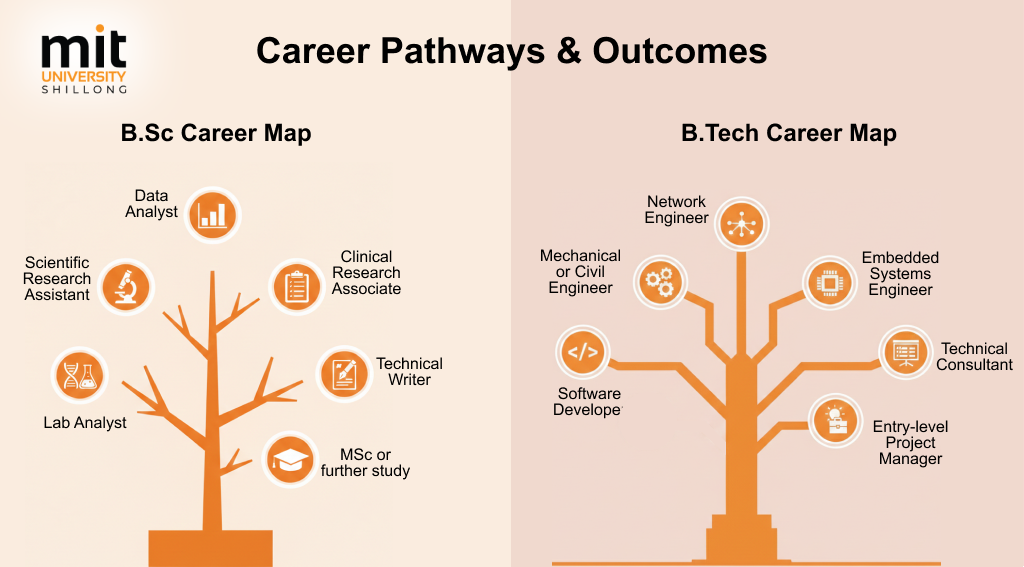
B.Sc Career Map
Here are some career options after B.Sc:
- Lab Analyst
- Scientific Research Assistant
- Data Analyst
- Clinical Research Associate
- Technical Writer
- MSc or further study
These jobs are suited for those who enjoy academic research or structured technical roles.
B.Tech Career Map
Career roles after B.Tech often include:
- Software Developer
- Mechanical or Civil Engineer
- Network Engineer
- Embedded Systems Engineer
- Technical Consultant
- Entry-level Project Manager
As you can see, the difference between B.Sc and B.Tech becomes clear in the job market as well. B.Tech offers more immediate placement in core industries.
Putting It All Together!
If you’re asking, should I choose B.Sc or B. Tech, it depends on your interest in theory versus application. B.Sc suits those aiming for academic or research paths, while B. Tech is more job-oriented and technical.
Some institutions offer both degrees and may allow course shifts early on, based on performance.
For those exploring broader options, the best BBA colleges in Shillong offer solid management pathways. Later, choosing the best college in Meghalaya can make a significant difference in terms of placements and academic quality.
FAQs
What are the main differences in the curriculum and duration between B.Sc and B.Tech?
A B.Sc. is a 3-year program that focuses on theory. B.Tech is a 4-year program that focuses on practical engineering and applied science.
Which career paths and salary prospects differ for B.Sc versus B.Tech graduates?
B.Tech graduates typically earn higher starting salaries and are placed in engineering sectors. B.Sc graduates may need further study for better opportunities.
Can a B.Sc graduate pursue engineering roles or higher technical studies like M.Tech?
Generally, no. M.Tech requires a B.Tech or equivalent engineering degree. However, some universities accept B.Sc graduates for postgraduate diplomas in applied fields.
Why should I choose MIT University’s B.Tech programme over a B.Sc degree?
MIT offers practical learning, an industry-linked curriculum, and strong placement support, which may not be available in standard B.Sc. programmes.