


Choose an MBA specialisation that matches India’s hiring needs and your strongest skill, then build proof through projects and tools. For Shillong students, the most reliable tracks stay consistent: Marketing, Finance, HR, Business Analytics, and Operations, with Hospitality and Travel offering strong regional relevance.
Use MBA career guidance to shortlist two domains, map the skills recruiters test, and prepare a portfolio before you apply. When you compare MBA colleges for students, focus on specialisation depth, internship access, and skill training, not brochure claims.
Start with your career goal, then pick the specialisation that gives you repeatable job options across industries.
Table of Contents
- Evolution of MBA Programs in India
- The Growing Demand for MBA Graduates in India
- Factors to Consider When Choosing an MBA Specialization
- What Makes an MBA Course ‘In Demand’?
- Types of MBA Courses in India Explained
- Top MBA Specializations with Promising Scope in India
- Emerging Trends in MBA Specializations
- Top High-Paying Specializations with Excellent MBA Future Scope
- Which MBA Specialization Gives the Highest Salary in 2026–27?
- Final Thoughts
- FAQs
Evolution of MBA Programs in India
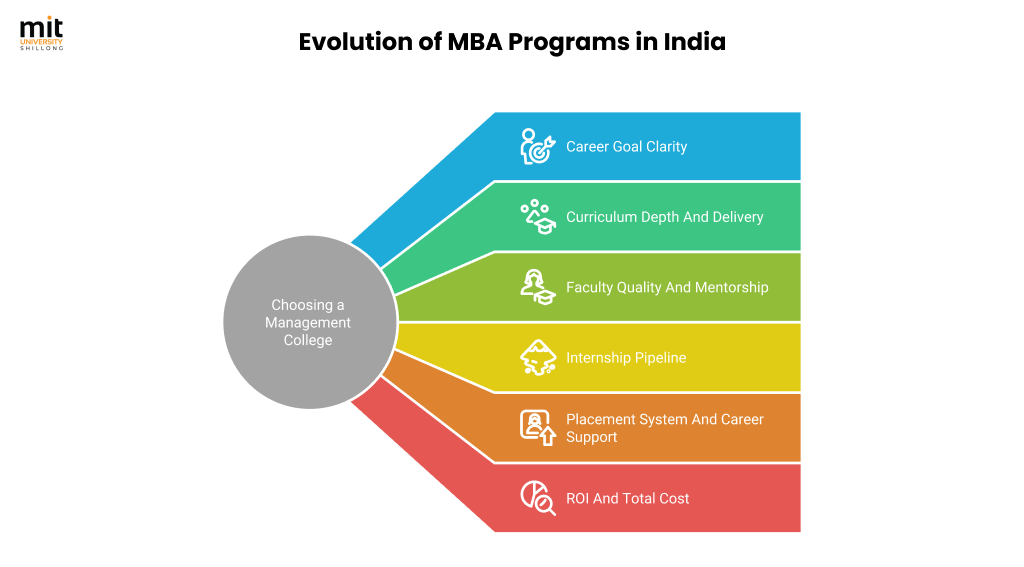
Indian MBA programs moved from textbook-first to outcome-first. Recruiters now pay for job-ready skills, not just a degree name.
In the 2000s, many MBA programs leaned heavily on theory and general management. Then the market changed. Indian companies scaled faster, startups started hiring MBAs, and global capability centres expanded in India. That forced MBA programs to specialise.
Today, the strongest MBA learning model looks like this:
- Core foundation (finance, marketing, operations, strategy)
- Specialisation depth (one or two domains you can defend in interviews)
- Execution skills (tools, presentations, dashboards, negotiation, stakeholder management)
- Industry exposure (projects, internships, live cases)
This shift matters for Shillong students because your specialisation becomes your identity in the first job market. A generic MBA still works, but a sharp specialisation often wins the shortlist faster.
Also, demand is not flat. MBA program applications in India grew ~26% in 2025, as part of a broader rise across Asia, while some Western regions saw declines. This tells you one thing: competition is rising, so your choice needs to be strategic.
The Growing Demand for MBA Graduates in India
MBA demand is rising because India needs managers who can scale revenue, control cost, and run operations at speed.
| Demand driver in India | What companies need from MBAs | High-hiring sectors | Common job outcomes |
| Growth-led economy | Revenue, GTM, category expansion | FMCG, retail, tech, services | Sales manager, growth, brand |
| Digitisation | Data-led decisions, automation | Fintech, e-commerce, SaaS | Business analyst, product ops |
| Complex hiring | Talent strategy, retention | IT services, hospitals, education | HRBP, TA lead, L&D |
| Supply chain pressure | Efficiency, procurement, planning | Logistics, manufacturing, D2C | Ops manager, SCM analyst |
| Financial risk focus | Risk, compliance, credit | BFSI, NBFCs, insurance | Risk analyst, credit manager |
That table shows a pattern. When the economy becomes complex, companies hire MBAs to reduce chaos. They do not hire you for “ideas”. They hire you for decisions that move metrics.
Factors to Consider When Choosing an MBA Specialization
Choose the specialisation where your interest meets hiring, and where you can build proof fast.
Use this checklist and do not skip steps:
- Your natural advantage
- If you enjoy persuasion and market behaviour, Marketing fits.
- If you like numbers and structured thinking, Finance or Analytics fits.
- If you like people systems and performance, HR fits.
- If you like process and execution, Operations fits.
- If you enjoy persuasion and market behaviour, Marketing fits.
- Skill proof you can show in 60 days
- Can you build a portfolio? A mini-project? A dashboard? A campaign plan?
- If you cannot show proof quickly, interviews get harder.
- Can you build a portfolio? A mini-project? A dashboard? A campaign plan?
- Hiring stability
- Some tracks hire in cycles. Some hire every quarter.
- Stable hiring reduces risk for first jobs.
- Some tracks hire in cycles. Some hire every quarter.
- Shillong reality
- You may prefer roles that allow remote work, or roles available in Northeast sectors like tourism and services.
- Your specialisation should not force relocation if you do not want it.
- You may prefer roles that allow remote work, or roles available in Northeast sectors like tourism and services.
- Your long game
- Think 5 years, not 5 months.
- Pick a domain where you can grow into leadership, not only entry roles.
- Think 5 years, not 5 months.
What Makes an MBA Course ‘In Demand’?

An MBA course becomes “in demand” when employers keep hiring for it across sectors and pay a premium for the skills.
A lot of students think demand comes from what sounds modern. That is not how hiring works. Recruiters care about one thing: can this person solve a business problem on day one, and can they keep solving bigger problems after six months?
Here’s what actually makes an MBA course “in demand” in India:
1) Companies can map it to business outcomes
If a specialisation links clearly to revenue, cost, or risk, hiring stays steady.
- Marketing links to revenue growth
- Operations links to efficiency and cost control
- Finance links to profitability and risk
- Analytics links to faster, better decisions
- HR links to retention and productivity
When the link is direct, companies do not treat it as optional.
2) The skill shortage is real, not temporary
Some domains face a talent gap because few people can do the job well. Analytics is a common example. Many people learn tools, but fewer can explain what the numbers mean in business language. That gap keeps demand high.
3) It works across industries
A course stays hot when you can shift sectors without starting from zero. Finance, HR, operations, and analytics travel well. Even marketing works across sectors if you understand positioning, customer behaviour, and funnels.
This matters for Shillong students because you may start in one sector and switch later. A cross-industry specialisation reduces risk.
4) There is a clear career ladder
Employers like roles with a predictable progression because it reduces training risk. A specialisation becomes “in demand” when it has clear next steps:
- Analyst → Senior Analyst → Manager → Head
- Executive → Lead → Manager → Business Partner
- Sales/Marketing → Team lead → Category/Brand lead
If a course leads only to niche roles with unclear growth, demand stays limited.
Types of MBA Courses in India
The “type” of MBA changes your learning pace, exposure, and placement path.
Here are the common formats, and what they mean in real life:
- Full-time MBA (2 years)
- Best for fresh graduates and early-career profiles
- Strongest pathway for internships, projects, and campus hiring
- Needs full commitment
- Best for fresh graduates and early-career profiles
- Executive MBA
- Built for working professionals
- Faster ROI if you already have experience and want a role upgrade
- Works well when learning links to your current job
- Built for working professionals
- MBA with industry-focused tracks
- Focus on one domain deeply
- Better interview clarity because your story stays consistent
- Focus on one domain deeply
- MBA with analytics layer
- Adds data skills across specialisations
- Helps in remote-first roles and metro job markets
- Adds data skills across specialisations
Your choice is not only “which specialisation”. It is also “which format fits my life and timeline”.
Top MBA Specializations with Promising Scope in India

The specialisations below win because they map to hiring volume plus salary growth.
1) Marketing and Growth
Marketing stays strong because every company needs demand. But the market now wants “growth marketers”, not only brand theory.
- Roles: Brand, Growth, Product Marketing, Category, Sales leadership
- What wins interviews: campaigns, GTM plans, customer research, CRM thinking
2) Banking and Finance
Finance stays premium because it controls capital and risk.
- Roles: Credit, Corporate finance, Risk, Relationship, FP&A
- What wins interviews: financial modelling basics, valuation thinking, credit logic
3) Human Resource Management
HR is no longer admin. It is performance systems, retention, culture, capability.
- Roles: HRBP, Talent acquisition, L&D, Compensation
- What wins interviews: hiring funnels, policy clarity, people analytics mindset
4) Business Analytics
Analytics sits inside every function now.
- Roles: Business analyst, MIS, Strategy analyst, Marketing analytics
- What wins interviews: dashboards, metrics logic, clear problem framing
5) Operations and Supply Chain
Operations stay relevant because cost and time decide survival.
- Roles: Operations manager, Procurement, Logistics, Process excellence
- What wins interviews: process maps, efficiency projects, vendor strategy
6) Hospitality and Travel Management
This matters for Shillong because tourism and services create real career paths.
- Roles: Hotel operations, travel business, service management, revenue operations
- What wins interviews: service design, customer experience mapping, partnerships
If you want the best MBA specialisation programs, do not chase what sounds fancy. Chase what recruiters can place into a role within 90 days of joining.
Emerging Trends in MBA Specializations
The next wave rewards MBAs who mix domain depth with digital execution.
Watch these shifts, because they change what “job-ready” means:
- Analytics inside every track: marketing analytics, HR analytics, risk analytics
- Fintech and digital lending roles expanding in BFSI
- Supply chain resilience focus: planning, vendor risk, inventory optimisation
- Customer experience becoming a leadership function
- Sustainability reporting and compliance becoming mainstream in larger firms
- AI tools changing work output expectations in strategy, marketing, and ops
These trends do not replace core specialisations. They upgrade them. A marketing MBA with analytics thinking beats a marketing MBA with only theory.
Top High-Paying Specializations with Excellent MBA Future Scope
High pay follows high impact and scarce skill.
Typically, these tracks command stronger compensation when you perform well:
- Finance + Risk
- Business Analytics
- Product-aligned Marketing and Growth
- Operations with strong execution projects
- Strategic HR with metrics and systems exposure
One caution: salary depends on role and performance, not the label alone. If you pick analytics but cannot interpret data in a business story, the market will not pay you a premium.
Which MBA Specialization Gives the Highest Salary in 2026–27?
In 2026–27, Finance and Analytics tracks usually lead for top-end salary, while Marketing can match them when you enter revenue-heavy roles.
Here is the practical ranking most students experience:
- Highest ceiling: Finance (investment, corporate finance, risk) and Analytics (strategy, BI, decision science)
- High and scalable: Marketing (growth, product marketing, enterprise sales)
- Stable and strong: Operations (large-scale execution, supply chain leadership)
- Steady and leadership-linked: HR (HRBP track with strong stakeholder work)
If you want the highest salary, do not only pick the highest-paying track. Build proof:
- Finance: modelling + credit thinking + case practice
- Analytics: dashboards + metric logic + business storytelling
- Marketing: portfolio + GTM thinking + funnel clarity
- Ops: process improvement story + cost saving logic
- HR: hiring strategy + performance systems + people metrics
MIT University Meghalaya aligns its MBA options with hiring-heavy functions while keeping access strong for Northeast students.
At MIT University Meghalaya, we position the MBA as a career tool, not just a classroom degree. The university also gets attention as the best college in Shillong choice for many local aspirants because it reduces relocation pressure without cutting ambition.
Final Thoughts
For your next step, shortlist two tracks, map the skills you must show in interviews, and start building proof this month. If you want structured MBA career guidance, explore specialisations early, compare outcomes, and choose among MBA colleges for students based on skills and placement support, not only brand talk.
If you are comparing MBA colleges in Shillong, speak to the admissions team, ask for specialisation-wise outcomes, and lock your plan.
Ready to choose your MBA track in Shillong? Enquire at MIT University Meghalaya and book your counselling slot today. Fill the admission form now.
FAQs
1. Which MBA specializations are in high demand in India and Shillong?
Marketing, Finance, HR, Analytics, Operations lead nationwide; Shillong also favors Hospitality and Travel for local opportunities.
2. Does an MBA in Finance have good job opportunities in India?
Yes. Banks, NBFCs, fintech, insurance, and corporates hire Finance MBAs for credit, risk, FP&A roles.
3. Can students in Shillong pursue high-demand MBA specializations through online or distance learning?
Yes, but outcomes need strong projects, industry exposure, networking, and proof of skills in interviews.
4. Do MBA specializations affect salary packages in India?
Yes. Finance and Analytics often pay higher; Marketing pays well in revenue roles; HR and Ops offer stable growth.
5. Which MBA specialization offers the best career growth in India?
Analytics and Finance grow fast with strong skills; Marketing grows fastest with consistent revenue performance and leadership.