

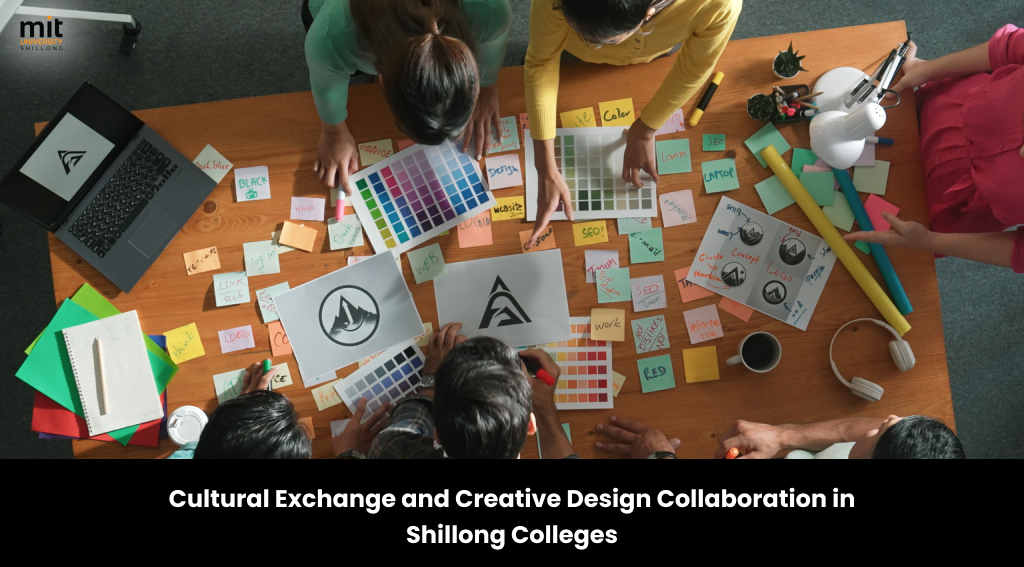
Shillong colleges build day-to-day cultural exchange because students from different regions live, learn, and create together. That rhythm strengthens soft skills education in a practical way, not as theory.
When creative arts programs in Shillong run with real briefs, students stop working in silos. They share references, debate choices, and deliver outcomes as one team. The right campus structure improves soft skills training through repeated practice like critiques, presentations, and role-based teamwork.
Over time, this shapes soft skills for students that employers notice fast: clarity, collaboration, and calm communication under deadlines.
Table Of Contents
- Why Shillong Is A Natural Hub For Cultural Exchange In Higher Education
- Role Of Colleges In Promoting Cultural Exchange In Shillong
- Forms Of Cultural Exchange And Creative Design Collaboration In Shillong Colleges
- Benefits Of Cultural And Creative Collaboration For Students
- MIT University Of Meghalaya Initiatives For Cultural Exchange And Creative Design Collaboration
- Final Thoughts
- FAQs
Why Shillong Is A Natural Hub For Cultural Exchange In Higher Education
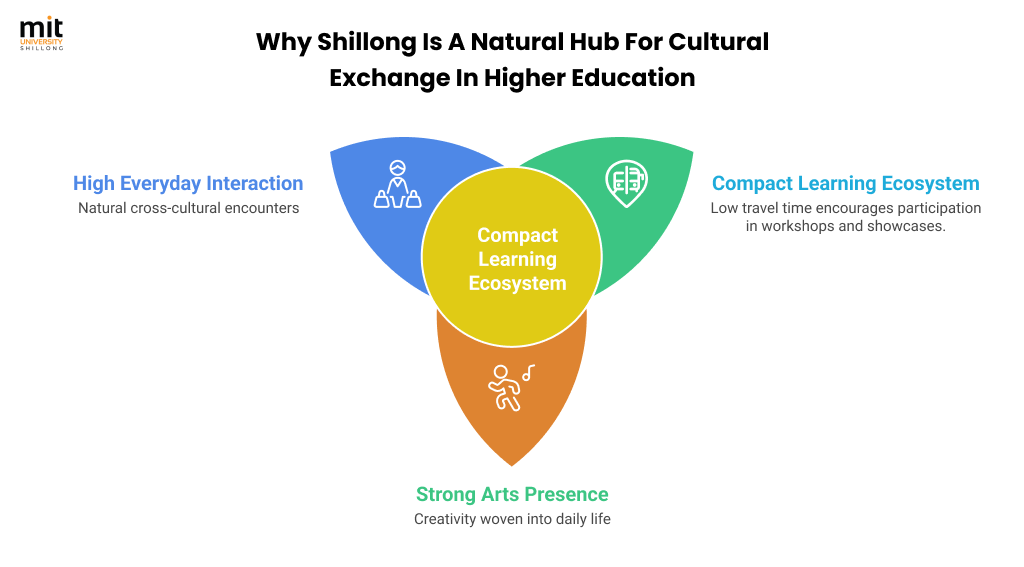
Shillong becomes a natural hub because students do not experience culture as a “special topic”. They experience it daily, through language, music, food, local markets, and public events. That steady exposure changes behaviour and makes collaboration feel normal.
Three reasons Shillong works so well in India:
- High everyday interaction: Students meet across backgrounds in classrooms, hostels, cafés, and city spaces.
- Strong arts presence: Music, performance, and craft are part of public life, so students see creativity as practical, not decorative.
- Compact learning ecosystem: People attend workshops and showcases because travel time stays low.
This matters for outcomes. When students regularly explain themselves to peers who think differently, soft skills training improves in a natural way. They learn to clarify, listen, and adjust without being told to “be professional”.
What Role Do Colleges Play In Promoting Cultural Exchange In Shillong
Colleges promote cultural exchange when they design routines that make students work with difference, not avoid it. If a campus only hosts one cultural fest, exchange stays shallow. If a campus builds exchange into coursework, it becomes a habit.
Here’s what effective colleges do consistently:
Build Cultural Contact Into Academics
They use:
- mixed-team assignments
- rotating leadership roles
- peer critique sessions with clear rules
- reflection notes and project documentation
These methods build soft skills for students because students must negotiate expectations, manage conflict, and present ideas in plain language.
Create Shared Goals That Force Collaboration
The easiest way to build cultural exchange is to give a shared target. For example:
- Solve a local problem through a project
- Build a prototype or campaign
- Present to a panel
- Improve based on feedback
The moment the goal becomes shared, students stop focusing on differences and start focusing on output.
Reward Teamwork Behaviour, Not Only Final Marks
When grading includes a process, students stop treating teamwork as “extra work”. They start treating it as the main work.
Which Formats Work Best For Cultural Exchange And Creative Collaboration In Shillong Colleges
The formats that work best are structured, repeated, and output-driven. One-off events feel good, but they do not build competence.
Below is a fast way to scan the main formats.
| Format | What Students Do | Skills Built |
| Mixed-Team Studio Projects | Solve a brief in diverse teams | teamwork, planning, conflict handling |
| Peer Critique Circles | Present work and give feedback | speaking, listening, clarity |
| Cultural Immersion Tasks | Interview communities and map needs | research, empathy, bias control |
| Joint Showcases | Exhibit work publicly and respond | confidence, audience handling |
| Global Partner Sessions | Attend workshops and joint reviews | global standards, professionalism |
If your priority is measurable soft skills training, pick two formats and run them every month. Frequency creates growth. Random events create memories only.
How Creative Arts Programs In Shillong Support Cross-Cultural Collaboration

Creative arts programs in Shillong support collaboration when they treat culture as a working input, not a stage performance. Students collaborate better when they create together, fail together, and fix together.
What strong creative programs typically include:
- Team briefs: projects that require shared output
- Public-facing work: showcases where students must explain choices
- Rules for critique: feedback that stays specific and respectful
- Process documentation: journals and portfolios that show thinking
This structure builds confidence and professional behaviour. It also helps students who are not in design-heavy degrees. For example, students searching for private colleges for BCom often want practical communication skills and portfolio-style proof of capability. Creative collaboration gives that.
Why The Benefits Of Cultural Diversity In Higher Education. Show Up In Real Outcomes
The benefits of cultural diversity in higher education. show up because diverse teams frame problems better and avoid narrow thinking. When students carry different assumptions, they question each other’s default choices.
You see outcomes in four clear ways:
Better Problem Framing
Diverse teams ask stronger questions early. They reduce “designing for ourselves” and improve relevance.
Stronger Communication Habits
Students stop assuming. They explain more clearly. They ask clarifying questions. This is the base of soft skills for students.
Wider Creative Range
Different cultural references expand storytelling, symbolism, and audience awareness. Students learn what resonates and why.
Better Employability Signals
Employers pay for people who can work with humans. Diversity-led collaboration becomes proof that a student can handle real teams.
This is also why students who compare top colleges for BCom still benefit from a campus culture that trains presentation, teamwork, and stakeholder communication.
How Collaborative Learning In Colleges Builds Workplace Readiness
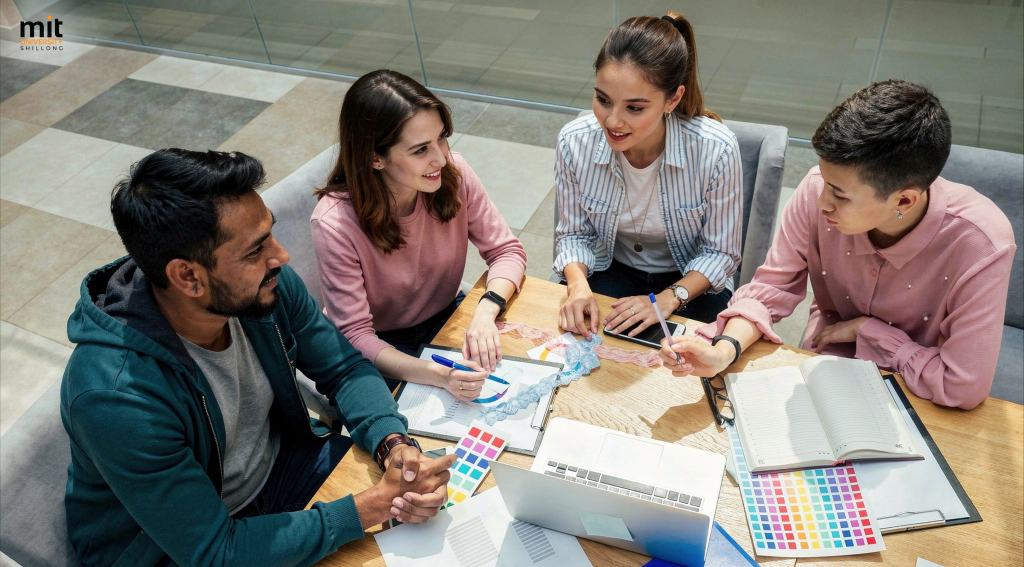
Collaborative learning in colleges builds workplace readiness because most jobs depend on coordination, not solo effort. A student can be brilliant alone and still fail in a team environment. Collaboration training prevents that.
The best collaborative learning systems include:
- Clear roles: researcher, designer, presenter, documenter
- Short sprints: weekly deliverables and reviews
- Feedback discipline: actionable comments, not vague praise
- Accountability: tracking contribution and follow-through
This is where soft skills education becomes practical. Students learn to manage deadlines, resolve disagreements, and communicate under pressure. They also learn how to present without panic.
For business-focused learners, these skills transfer cleanly to marketing, client servicing, business development, and even finance communication. That is why students researching top colleges for MBA in finance should still care about collaboration culture earlier in their academic journey.
What Students Gain From Cultural And Creative Collaboration
Students gain skills that show up in interviews, internships, and client-facing roles. These are not “nice-to-have” traits. Recruiters screen for them.
Key gains:
- Clear speaking and structured thinking
- Conflict resolution without ego battles
- Decision-making under constraints
- Leadership practice through rotation
- Stronger portfolios with teamwork proof
This directly supports soft skills training because students practise professional behaviour repeatedly. It also improves soft skills for students because confidence comes from repetition, not motivation.
What We Do At MIT University Shillong For Cultural Exchange And Design Collaboration
At MIT University Shillong, we treat cultural exchange as a learning system, not a one-time event. Students experience exposure through structured partnerships and practical formats that connect to real academic outcomes.
Many learners also search for the best college in Shillong when they want industry-linked learning. Our approach fits that need because it blends international collaboration with project delivery.
- MIT University Shillong has formal international creative collaborations with two design partners. We signed an MoU with The Sustainable Design School, Nice (France) in September 2021 and it focuses on student exchange, faculty development programmes, and joint research.
- We also signed an MoU with Leeds Arts University (UK) in April 2023. This partnership supports joint academic activities like courses, conferences, seminars, and lectures. It also supports collaborative research projects and exchange of publications and academic material.
The Office of International Affairs at MIT University actively supports initiatives that foster cultural exchange and collaboration through workshops and events that bring students together across backgrounds to encourage cultural understanding and cooperative engagement.
We keep the focus on outcomes. Students do not only attend events. They produce work, present it, and improve through critique.
Final Thoughts
In Shillong, collaborative learning in colleges works when teamwork is built into weekly academic routines, not treated as an optional activity. The benefits of cultural diversity in higher education. show up in better problem framing, stronger communication, and more mature decision-making across teams.
With creative arts programs in Shillong, students translate culture into real output through briefs, prototypes, and public-facing showcases.
Consistent practice sharpens soft skills training that fits internships, client work, and interviews.
If you want structured global exposure and strong collaboration outcomes, apply to MIT University Shillong today and book your counselling slot now.
1. How Do Shillong Colleges Promote Cultural Exchange And Design Collaboration?
They promote it by building mixed teams in coursework, running regular studio critiques, and pushing students to present work to diverse peer groups. At MIT University Shillong, we also connect exposure to outcomes through structured international and local engagement.
2. What Programs Encourage Student Collaboration In Shillong Colleges?
Team-based projects, portfolio studios, peer review circles, research-led assignments, and campus showcases encourage collaboration because students must deliver one shared output, not individual submissions.
3. What Cultural Events Help Foster Collaboration Among Students In Shillong?
Events work best when they are linked to a project goal, like exhibitions, performances with documentation, theme-based design showcases, and community-focused campaigns where students plan, build, and present together.
4. Are There Opportunities For Cross-Disciplinary Projects In Shillong Colleges?
Yes. Cross-disciplinary projects happen when colleges allow students from different streams to work on shared briefs such as branding, communication strategy, user research, event design, or community problem-solving projects.
FAQ