


For many engineering graduates, the natural next step seems to be a master’s degree. But there’s another path worth considering — going straight from a B.Tech into a PhD. If your goal is advanced research, cutting-edge innovation, or a high-level academic career, this option can help you achieve it sooner. The main thing is to understand how the process works, what universities expect, and how to prepare yourself.
This guide explains how to pursue a PhD after B.Tech.
PhD Eligibility & Prerequisites

Academic Requirements
Not every institution offers this route, but those that do usually have high entry standards. Typical requirements include:
- A consistently strong academic record (often a CGPA of 8.0/10 or higher).
- Strong evidence of research potential, such as published papers or significant project work.
- A valid score in recognised entrance exams like GATE, CSIR-NET, or a university-specific test.
The top colleges for direct PhD after B.Tech also assess your clarity of research goals and recommendations from faculty.
Bridging Courses at MIT University
Students entering a doctoral programme straight after B.Tech at MIT University Shillong may be advised to take select postgraduate-level courses.
These are designed to strengthen areas such as:
- Advanced theoretical concepts
- Research methodology
- Specialised domain knowledge
This ensures that when you begin your PhD, you’re equipped to meet the academic demands from day one.
Pathways from B.Tech to PhD
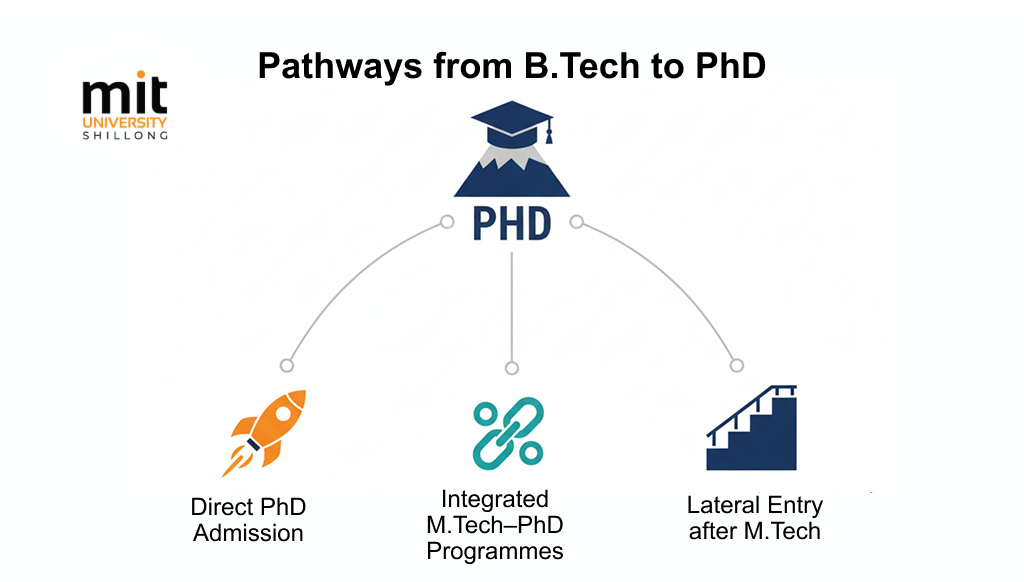
Direct PhD Admission
Direct entry allows you to enrol in a doctoral programme without first completing a master’s degree.
- Ideal for high-achieving graduates with a clear research proposal.
- Admission is usually competitive, with a strong focus on academic performance and research aptitude.
Integrated M.Tech–PhD Programmes
- Combines master’s and doctoral studies into one continuous course.
- Duration: typically 5–7 years.
- Provides time to develop advanced technical skills before embarking on full-time research.
Lateral Entry after M.Tech
- Complete your M.Tech first, then apply for PhD admission.
- Allows more time to refine research interests and gain more profound subject expertise.
Research Areas & Resources at MIT University

Key Research Domains
MIT University Shillong offers a range of specialisations for students pursuing a PhD after B.Tech, like Computer Science and Engineering. It is one of the best colleges in Meghalaya for engineering research.
Supporting Infrastructure
Doctoral students benefit from:
- Well-equipped laboratories and research centres.
- Access to leading journals and academic databases.
- Collaboration opportunities with industry and other universities.
- Guidance from experienced faculty and visiting experts.
Wrapping Up!
Pursuing a PhD after B.Tech can fast-track your entry into advanced research and open doors to specialised career paths. MIT University Shillong offers structured guidance, strong academic networks, and resources that help you progress with clarity. Pairing research with management studies, such as an MBA in Shillong, can further expand your professional reach.
FAQs
Can I apply directly for a PhD after completing my B.Tech without an M.Tech?
Yes. If you have a strong academic record and meet entrance exam criteria, certain universities, including some of the top colleges for direct PhD after B.Tech, offer this route.
Which entrance exams and academic criteria are required for a PhD admission post–B.Tech?
Typical requirements include a CGPA of 8.0/10 or higher and qualifying in exams such as GATE, CSIR-NET, or the university’s own test.
What research specialisations are available for B.Tech graduates at MIT University India?
Specialisations may include core engineering fields such as Computer Science, Civil Engineering, Mechanical Engineering, and Electronics, alongside emerging areas like renewable energy.
How long does a typical PhD programme take after a B.Tech, and what is its structure?
Direct PhDs typically take five to six years, beginning with coursework and comprehensive exams, followed by research, publication, and thesis defence.
What scholarships, fellowships, or assistantships can B.Tech graduates’ access to PhD studies?
Funding can include government fellowships (such as CSIR and UGC), institutional scholarships, or research assistant positions, depending on eligibility and performance.